Running Dade Firefighters Through the Smoke Maze
May 5, 1984
In the spring of 1984, Training Lt. William Gustin was one of the Metro-Dade training officers chosen to run the department’s first training in a dark, superheated breathing-apparatus maze, and to judge whether the county should buy one.
The Dräger respiratory training center was on loan to Metro-Dade for three weeks. Lt. Gustin and his fellow training officers kept it running from 7 a.m. until 10 p.m., putting as many firefighters from around Dade County through it as they could. It was the first time Dade firefighters had trained this way.
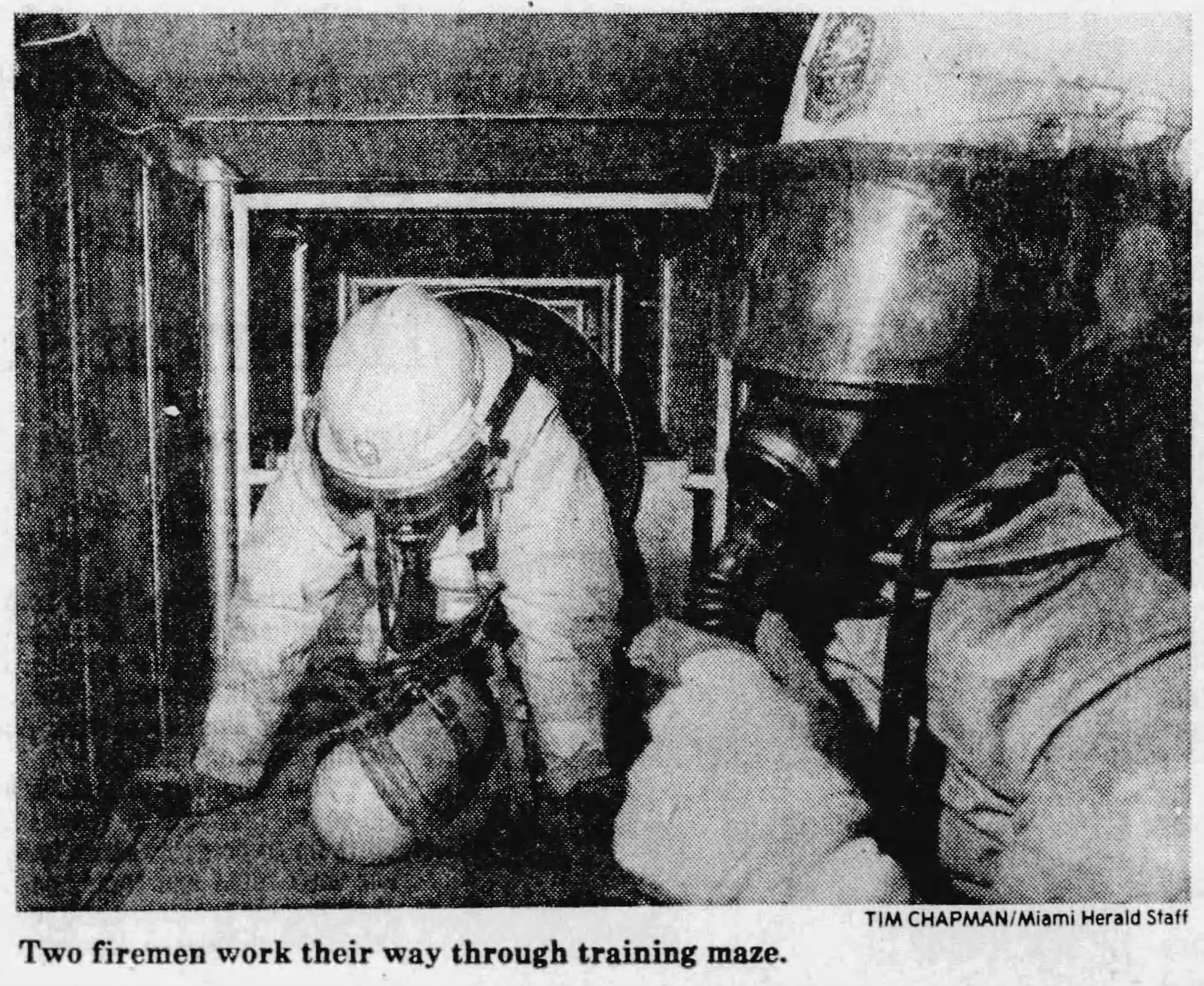
Built inside a semi-trailer, the maze was pitch dark and kept at over 100 degrees. Firefighters crawled through trap doors, scuttle holes and tight passages in full gear and on air, after first climbing a ladder treadmill and dragging a simulated hoseline. From a control room, Gustin and the other instructors watched them on infrared cameras.
The evaluation Gustin and the training staff gave the unit was expected to weigh heavily on whether the county spent an estimated $150,000 to buy one. Fire chiefs from across the county came to watch and left impressed.
The original article
Maybe it should be called the National Respiratory Torture Center.
"It’s a series, a maze with trap doors, alternate routes, short ladders, scuttle holes like on board ships, boards like rafters," Metro Fire Chief Ed Donaldson said, an evil smile creasing his face.
"It’s also completely dark. It’s designed to frustrate a fireman, teach them to control themselves, to use their mind and their body, to control their breathing and maneuver stuff through lousy conditions."
It’s actually called the National Draeger Inc. Respiratory Training Center. It’s a maze set up in a full-size, semi-trailer truck van.
Trainees crawl through it in full battle regalia: helmet, air tank, face mask, rubber insulated suit, heavy boots.
It’s kept hot to approximate fire conditions more closely. Friday, it was 101.2 degrees. Temperatures in rooms actually on fire can reach 1,200 to 1,400 degrees, fireman John F. Carroll said.
The center has an air-conditioned control room with infrared cameras so training officers can monitor the firemen as they struggle through the hot blackness, crashing their helmets and air tanks on walls and closed doors and barricades. A sound track of oddball noises adds to the confusion and drowns out the swearing.
The maze can be changed into 30 different configurations, Draeger distributor Bob Milnes said, so firemen can have a new frustrating, agonizing and physically demanding experience each time they crawl through.
The concept was pioneered in Germany and built in the United States. With modifications it would cost the county $150,000 to buy, Donaldson said. And, given the reaction of the men and training officers who have worked with the center over the last week and a half, it might be worth considering, he said.
The center is on loan for three weeks to the Metro fire department, and training Lt. William Gustin and his colleagues have been running as many local firemen as possible through the center, starting each morning at 7 a.m. and stopping at 10 p.m.
It is the first time Dade County firemen have had the training and experience. Their evaluation of its effectiveness will be a crucial criterion for possible acquisition.
Friday, fire chiefs from throughout Dade County dropped by to see how it worked. They were impressed.
"I think it’s excellent. Superb," said Homestead Air Force Base fire chief Marty Jester. "It’s an ever-changing environment. Realistic. It makes a man realize he has to think things out to survive."
Fireman Carroll was my partner in a crawl through the training center. We encountered the "endless ladder," which is a ladder treadmill that simulates climbing. There was also a device that simulates the weight of pulling a hose. Before any fireman gets to crawl through tiny hot places, he must first climb up ladders and drag heavy hoses. I was weak from walking up six stairs.
Inside my helmet I heard my heart thump like the rhythm section of a marching band.
We crawled over things and under things, around things and down through things. I don’t know what things, I couldn’t see them. Sitting up was hard, standing impossible.
For those who have ever wrestled or boxed, that was the kind of fatigue the heat and crawling created: deep down, bone- melting fatigue.
And -- when that sensation is mixed with fear and death in a real fire -- it became a puzzle to me how anyone is saved. How could you possibly do this and then actually drag somebody out? Or carry them?
© 1984 The Miami Herald. Reprinted with permission.
Also reported in The News-Press (Fort Myers), May 6, 1984, page 31; The Palm Beach Post, May 13, 1984, page 35.