Armenia, 1988
December 1988 – March 1989
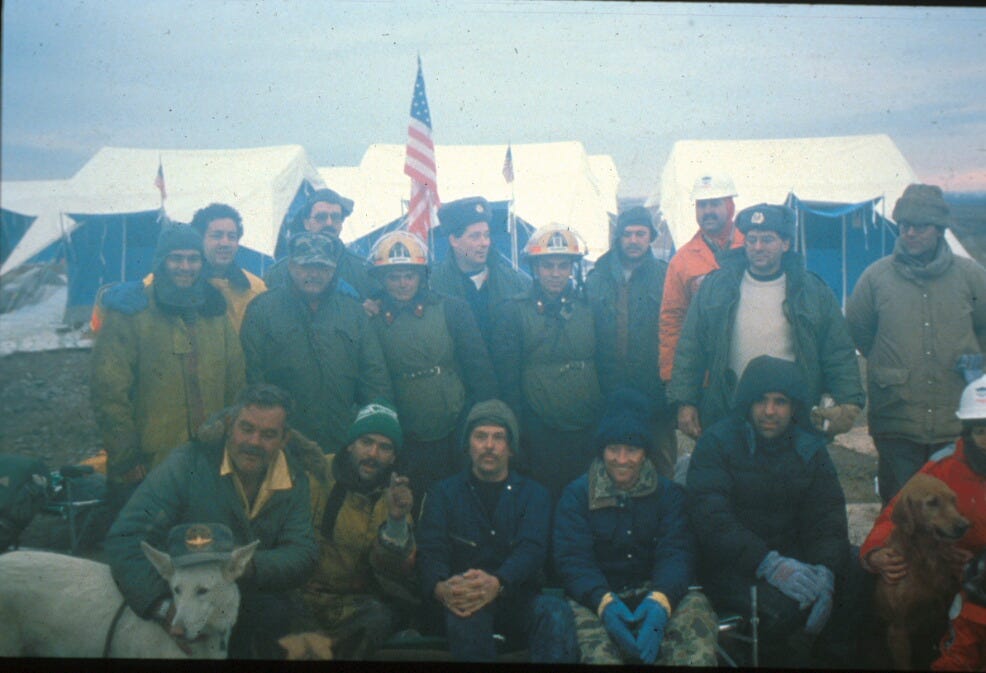
On December 7, 1988, an earthquake leveled much of northern Armenia. Three days later Captain Gustin left Miami with Metro-Dade’s international disaster team, part of the first American rescue effort the Soviet Union had asked for since World War II.
Working beside a team from Fairfax County, Virginia, under the U.S. Office of Foreign Disaster Assistance, the Metro-Dade crew spent six days in the ruins of Leninakan. This page brings together the whole story: the newspaper coverage of their departure, his own account of the mission for Firehouse magazine with the photographs he took, the coverage of his homecoming, and the team’s visit to the White House. Two years later he deployed again, to the Philippines earthquake. He was a member of the International Rescue Task Force for the U.S. Office of Foreign Disaster Assistance and later served as an instructor and advisor for the U.S. Agency for International Development.
On this pageLeaving for ArmeniaIn his wordsPhotographsHome from ArmeniaThe White HouseSources
Leaving for Armenia
December 11, 1988
Three days after a massive earthquake struck Soviet Armenia on December 7, 1988, Bill Gustin left Miami as one of seven members of Metro-Dade’s specially trained disaster team, chosen to join the largest American aid effort to the Soviet Union since World War II.
The State Department had asked Metro-Dade for as many qualified people in special disasters as it could send. The department sent the people it judged best for the job, and Gustin was among them, alongside Bill McIntyre, Carlos Castillo, Jim Arias Sr., Raul Chavez, Doug Jewett and Al Jewett, with Lt. Joaquin del Cueto already in Washington to coordinate.
They left Miami at 8 a.m. on Saturday, December 10, and flew out of Andrews Air Force Base that day. The team they joined, Metro-Dade’s International Disaster Response team, had already worked the 1985 Mexico City and 1986 San Salvador earthquakes.
The original articles
Seven members of a specially trained Metro-Dade disaster team headed for quake-shattered Armenia on Saturday to participate in a massive humanitarian mission that has quickly grown into the greatest extension of U.S. aid to the Soviet Union since the superpowers were World War II allies.
The Dade Fire and Rescue workers were joining a State Department-sponsored aid effort that was being augmented by such disparate private-sector figures as financier Armand Hammer and South Florida-based arms dealer Sarkis Soghanalian.
In Washington, President-elect George Bush called for an unfettered flow of aid.
"If something has to be changed to expedite help to the people, it should be done," Bush said after going to the Soviet Embassy to offer condolences. "I know of no barriers."
Bush and his wife Barbara both wore mourning black. They were among a stream of sympathetic visitors to the embassy.
The seven Dade men left Miami at 8 a.m. for Washington, where the State Department made arrangements for them to board an aid flight later in the day.
The educational background of one of the men, Bill McIntyre, will be particularly helpful.
"He’s multilingual. He speaks Russian -- that’s important," said department spokeswoman Jacqueline Ramos.
The other firefighters were Carlos Castillo, a paramedic; Jim Arias Sr., a logistics specialist; Bill Gustin; Raul Chavez; Doug Jewett; and his nephew Al Jewett. They were to join another member of the department, Joaquin del Cueto, who left Miami on Friday.
Ramos said it was unclear Saturday when the Dade team would begin to aid quake victims.
"Once they left Miami, they were turned over to the State Department. We’re lending them," she said. "We gave them the ones we thought could do the best job for what they needed."
Another member of the Dade aid squad, hazardous-materials expert John Mitchell, will go to the Soviet Union as soon as his travel papers are in order, Ramos said.
Over the past several years, the county’s International Disaster Response team has helped to find and save victims of such disasters as the earthquakes of Mexico City in 1985 and San Salvador in 1987.
One of the first relief flights to leave the United States for Armenia on Saturday was flown by a Miami charter company, Southern Air Transport.
The company was chartered to fly a cargo-model Boeing 707 with a 95,000-pound load of medical and other supplies to the Armenian capital of Yerevan.
The aircraft was loaded Saturday morning at New York’s John F. Kennedy International Airport for an afternoon departure, Southern Air spokesman Jack Thale said.
"We’ve developed a pretty good expertise in flying these missions," he explained. "We flew some relief missions in Ethiopia for United Nations and are currently flying in southern Sudan for the United Nations, then did an earthquake relief job in Ecuador last June for an agency of the British government."
Miami arms dealer Soghanalian, meanwhile, expected to send three cargo planes with medical personnel and supplies late Saturday or today.
Soghanalian, owner of Pan-Aviation Inc., said he was preparing to fly three Boeing 707s loaded with relief supplies donated from South Florida’s community of about 2,000 Armenians.
Forty doctors and nurses from Miami, Chicago, Los Angeles and Boston have volunteered to go along, he said.
Among them was Dr. Robert Gale of Los Angeles, who helped treat radiation victims of the 1986 Chernobyl nuclear disaster.
Gale said the political complications in Armenia were less pronounced than at Chernobyl, where Soviet authorities were criticized for maintaining secrecy after the nuclear accident that carried radiation to neighboring countries.
The first U.S. relief flight left Dulles International Airport early Saturday with 26 disaster relief specialists, cargo and eight dogs trained to sniff out survivors buried in rubble.
Richard Schubert, president of the American Red Cross, said that to his knowledge it marks the first time that shipments of emergency supplies have been accepted by the Soviet Red Cross.
"The tremendous outpouring of aid . . . clearly demonstrates that humanity transcends political and geographic frontiers," he said.
At Los Angeles International Airport, workers loaded an Occidental Petroleum Boeing 727 corporate jet with 2,300 pounds of medical supplies mostly donated by the Red Cross. The jet was also taking $1 million contributed by Occidental and World
Vision, a privately funded international Christian relief agency.
Occidental is chaired by Armand Hammer, who has long had ties with the Soviet Union.
© 1988 The Miami Herald. Reprinted with permission.
This article is summarized above and is not reprinted here. © 1988 News and Sun-Sentinel Company
Also reported in The News-Press (Fort Myers), December 11, 1988; The Stuart News, December 11, 1988.
In His Words: “Rescue in Armenia”
Firehouse magazine · March 1989
Three months after coming home from Leninakan, Captain Gustin wrote the story of the Armenia mission for Firehouse magazine, and he took the photographs that ran with it.
His article goes well beyond the headlines. It explains why Soviet precast buildings collapsed the way they did, how the Metro-Dade and Fairfax crews planned their searches around that, and how they spent five hours freeing a woman trapped in a void beneath a fallen floor slab, then pulled a young girl out alive the same day. He closed with the lessons he wanted every rescuer to take from it, from rotating crews and keeping an “inside man” with the victim to bringing a simple army shovel.
The original article
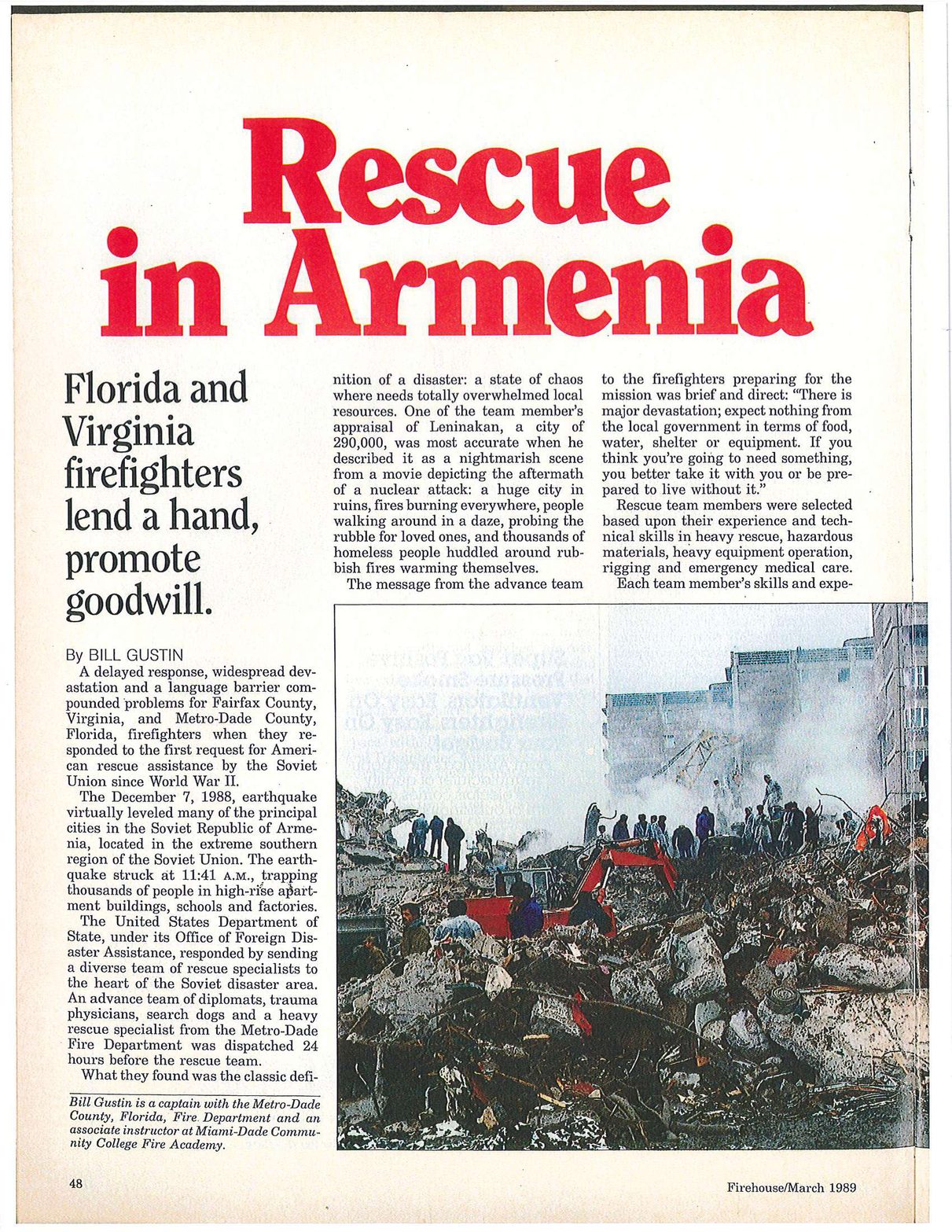
A delayed response, widespread devastation and a language barrier compounded problems for Fairfax County, Virginia, and Metro-Dade County, Florida, firefighters when they responded to the first request for American rescue assistance by the Soviet Union since World War II.
The December 7, 1988, earthquake virtually leveled many of the principal cities in the Soviet Republic of Armenia, located in the extreme southern region of the Soviet Union. The earthquake struck at 11:41 a.m., trapping thousands of people in high-rise apartment buildings, schools and factories.
The United States Department of State, under its Office of Foreign Disaster Assistance, responded by sending a diverse team of rescue specialists to the heart of the Soviet disaster area. An advance team of diplomats, trauma physicians, search dogs and a heavy rescue specialist from the Metro-Dade Fire Department was dispatched 24 hours before the rescue team.
What they found was the classic definition of a disaster: a state of chaos where needs totally overwhelmed local resources. One of the team member’s appraisal of Leninakan, a city of 290,000, was most accurate when he described it as a nightmarish scene from a movie depicting the aftermath of a nuclear attack: a huge city in ruins, fires burning everywhere, people walking around in a daze, probing the rubble for loved ones, and thousands of homeless people huddled around rubbish fires warming themselves.
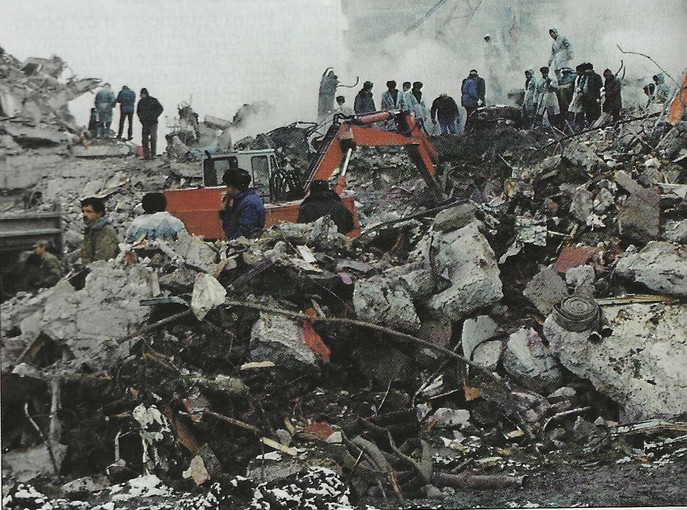
The message from the advance team to the firefighters preparing for the mission was brief and direct: “There is major devastation; expect nothing from the local government in terms of food, water, shelter or equipment. If you think you’re going to need something, you better take it with you or be prepared to live without it.”
Rescue team members were selected based upon their experience and technical skills in heavy rescue, hazardous materials, heavy equipment operation, rigging and emergency medical care. Each team member’s skills and experience contributed to the overall mission. The principal members were:
- Ten heavy rescue specialists from the Fairfax County Fire Department, many of whom are members of Fairfax’s cave-in rescue unit under the command of Battalion Chief Mike Tamallow.
- Eight building collapse specialists from the Metro-Dade County Fire Department under the command of Foreign Disaster Coordinator Doug Jewett, who directs the State Department’s Foreign Disaster Team. Most of his people are veterans of earthquake rescues in Mexico City, El Salvador and the Bridgeport, Connecticut, construction accident. Battalion Chief Bill McIntyre, who speaks fluent Russian, was an asset as an interpretor.
- Handlers and search dogs trained to detect human life beneath rubble.
- A medical team, headed by Dr. Jim Dugal of Atlanta, Georgia, to treat members for sickness or injury.
- Dr. Fred Krimgold, associate dean of architecture at Virginia Polytechnic Institute, served as technical advisor. Krimgold is an internationally known researcher on earthquake hazard mitigation. As technical advisor, he provided the team with vital information regarding the strength and stability of Soviet construction methods and materials; the reaction of local materials to cutting, lifting, prying and digging; the behavior of Soviet buildings in an earthquake; and possible locations of viable victims in areas of refuge and voids formed in the buildings collapse.
On December 10, the rescue team boarded an Air Force C-141 cargo plane, loaded with relief supplies and rescue tools for a 12-hour flight from Andrews Air Force Base near Washington, DC, to Armenia. Upon arriving in the USSR, the American team began operations in Leninakan.
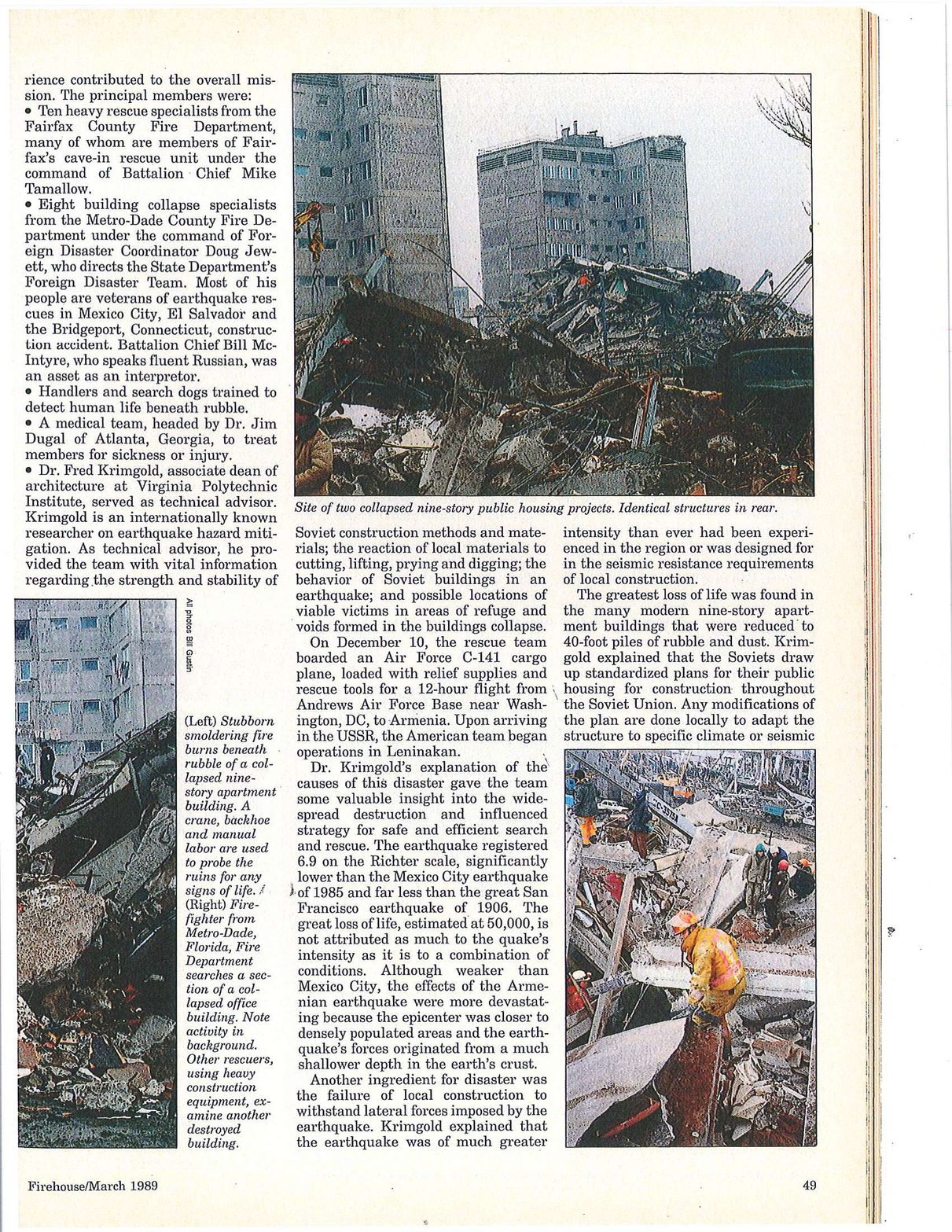
Dr. Krimgold’s explanation of the causes of this disaster gave the team some valuable insight into the widespread destruction and influenced strategy for safe and efficient search and rescue. The earthquake registered 6.9 on the Richter scale, significantly lower than the Mexico City earthquake of 1985 and far less than the great San Francisco earthquake of 1906. The great loss of life, estimated at 50,000, is not attributed as much to the quake’s intensity as it is to a combination of conditions. Although weaker than Mexico City, the effects of the Armenian earthquake were more devastating because the epicenter was closer to densely populated areas and the earthquake’s forces originated from a much shallower depth in the earth’s crust.
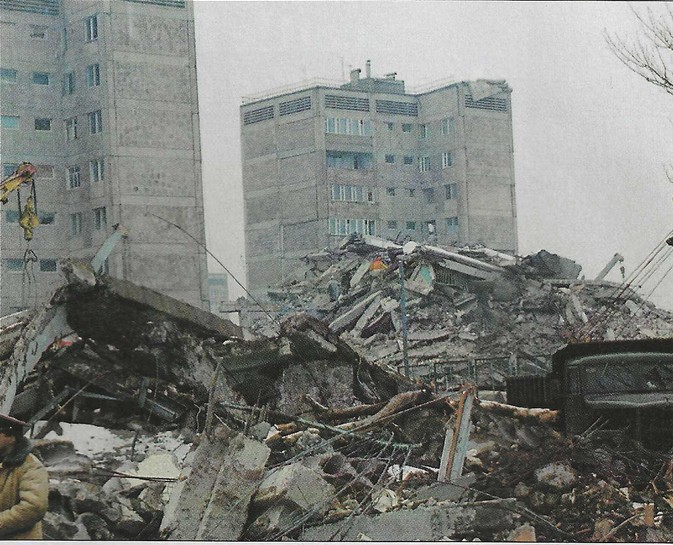
Another ingredient for disaster was the failure of local construction to withstand lateral forces imposed by the earthquake. Krimgold explained that the earthquake was of much greater intensity than ever had been experienced in the region or was designed for in the seismic resistance requirements of local construction.
The greatest loss of life was found in the many modern nine-story apartment buildings that were reduced to 40-foot piles of rubble and dust. Krimgold explained that the Soviets draw up standardized plans for their public housing for construction throughout the Soviet Union. Any modifications of the plan are done locally to adapt the structure to specific climate or seismic conditions. He stated that height limitations and earthquake resistance requirements apparently were relaxed prior to the construction of the majority of these structures.
The standard plan calls for a nine-story building of precast columns, beams and floor panels. He explained that this kind of construction is very dependent on the integrity of connections between precast components, which must be accomplished with extreme precision to approximate the strength and stability of a monolithic structure. It is critical to join reinforcing steel bars from each component with sufficient overlap and an accurate weld. It is the failure of these connections that accounted for the total collapse of a number of Soviet buildings constructed during the building boom of the late 1970s.
The precast frames and lightweight floor panels tend to disintegrate, which accounted for the very few voids formed by lean-to collapse and few live victims to be found. This contrasts to the heavy, cast-in-place construction in Mexico City. There, substantial floor slabs provided areas of refuge to victims of the 1985 earthquake.
The nature of the precast components had a strong influence on the rescue team’s tactics and strategy. The lightweight floor planks easily were penetrated by small hand tools and conversely, heavy cranes and prying equipment caused them to break apart and shower trapped victims with chunks of concrete.
Standard Soviet plans place the stairways and elevator shafts in a center core in the front of the apartment buildings. The center core would be one of the few places in which to find live victims and thus, received search priority for two reasons: First, the earthquake lasted 90 seconds with an aftershock of lesser intensity three minutes later. This would have given occupants significant time to begin their escape by stairway or elevator. Second, the shear wall forming one side of the elevator shaft was strong enough for its sections to stay intact and form lean-to voids.
Operations. The American team set up base camp at the airport on the outskirts of town. This Spartan, yet self-sufficient, tent city became the base of operations, tool staging and distribution of relief supplies.
The American plan was to divide the team into two squads—one squad of Dade and Fairfax firefighters would travel by bus to conduct search and rescue operations in the city. The ever-present possibility of entrapment and injury to members in the course of their work required a backup team to remain staged at the base camp, ready to respond to the rescue of their brother firefighters.
The local government’s inability to coordinate the many international response teams resulted in two major problems: the duplication of effort, at the expense of buildings being neglected, and conflicting strategies, particularly in methods of locating victims. A spirit of cooperation allowed the teams of many countries to work in harmony.
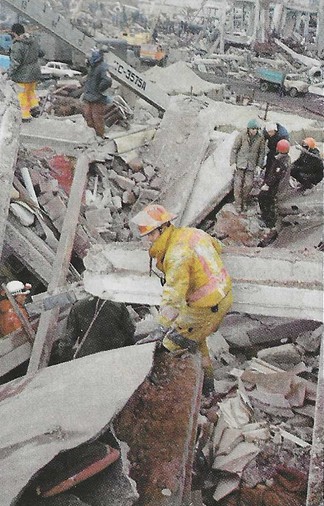
Buildings were searched in response to reports of possible victims from search dogs, local government officials and other international teams. A particularly grim task was dealing with a deluge of reports of “voices in the rubble” by relatives of people missing in collapsed buildings. Veterans of previous earthquakes had dealt with these reports before. They explained that most of these were futile attempts by grieving relatives unable to give up hope that a loved one still was alive, even after being buried for days in subfreezing temperatures.
The delayed response of the American team, six days after the earthquake struck, accounted for the diminished survivability rate of victims still trapped in the rubble. The successful rescue of two victims tremendously lifted the spirits of team members and proved their tactics, strategy and operational assignments were accurate and appropriate.
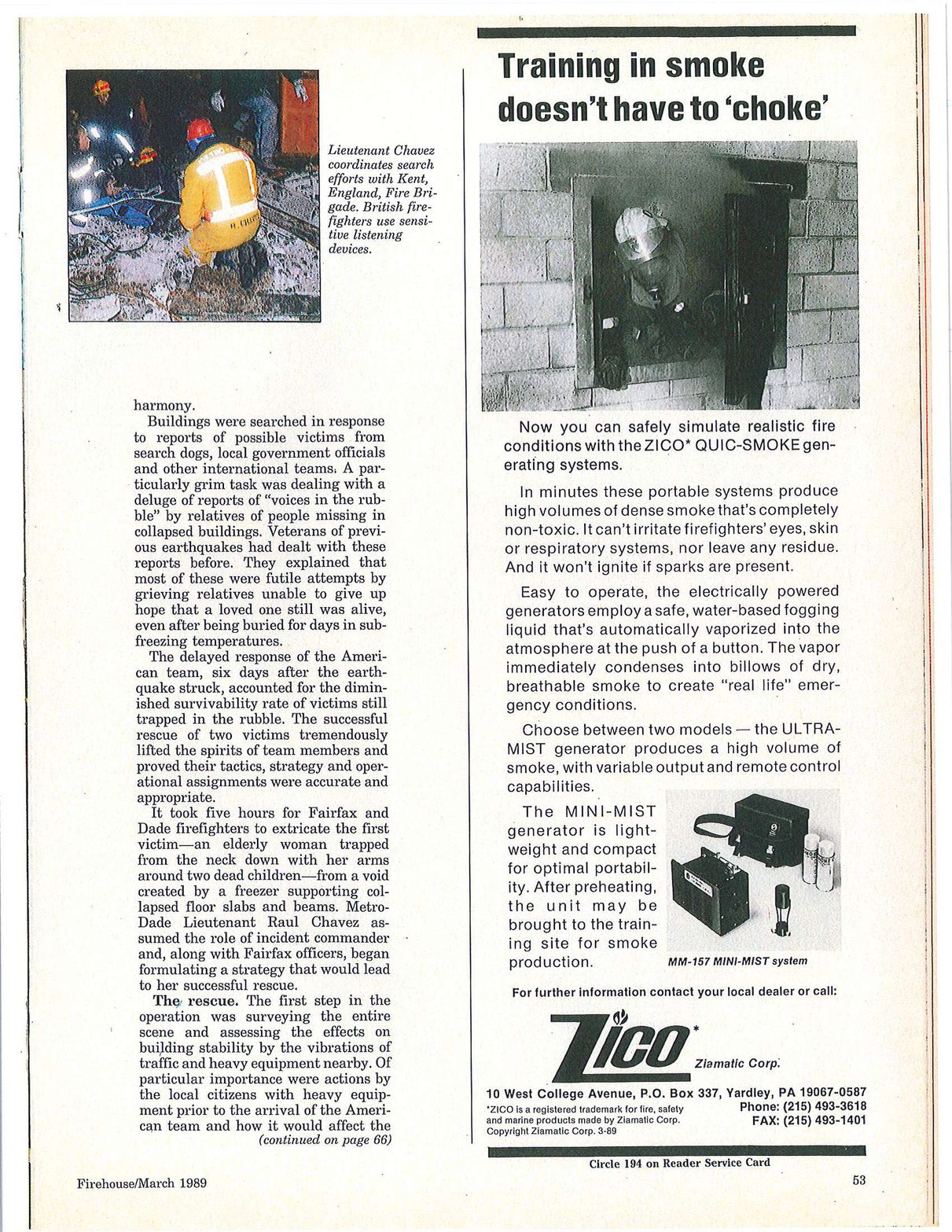
It took five hours for Fairfax and Dade firefighters to extricate the first victim—an elderly woman trapped from the neck down with her arms around two dead children—from a void created by a freezer supporting collapsed floor slabs and beams. Metro-Dade Lieutenant Raul Chavez assumed the role of incident commander and, along with Fairfax officers, began formulating a strategy that would lead to her successful rescue.
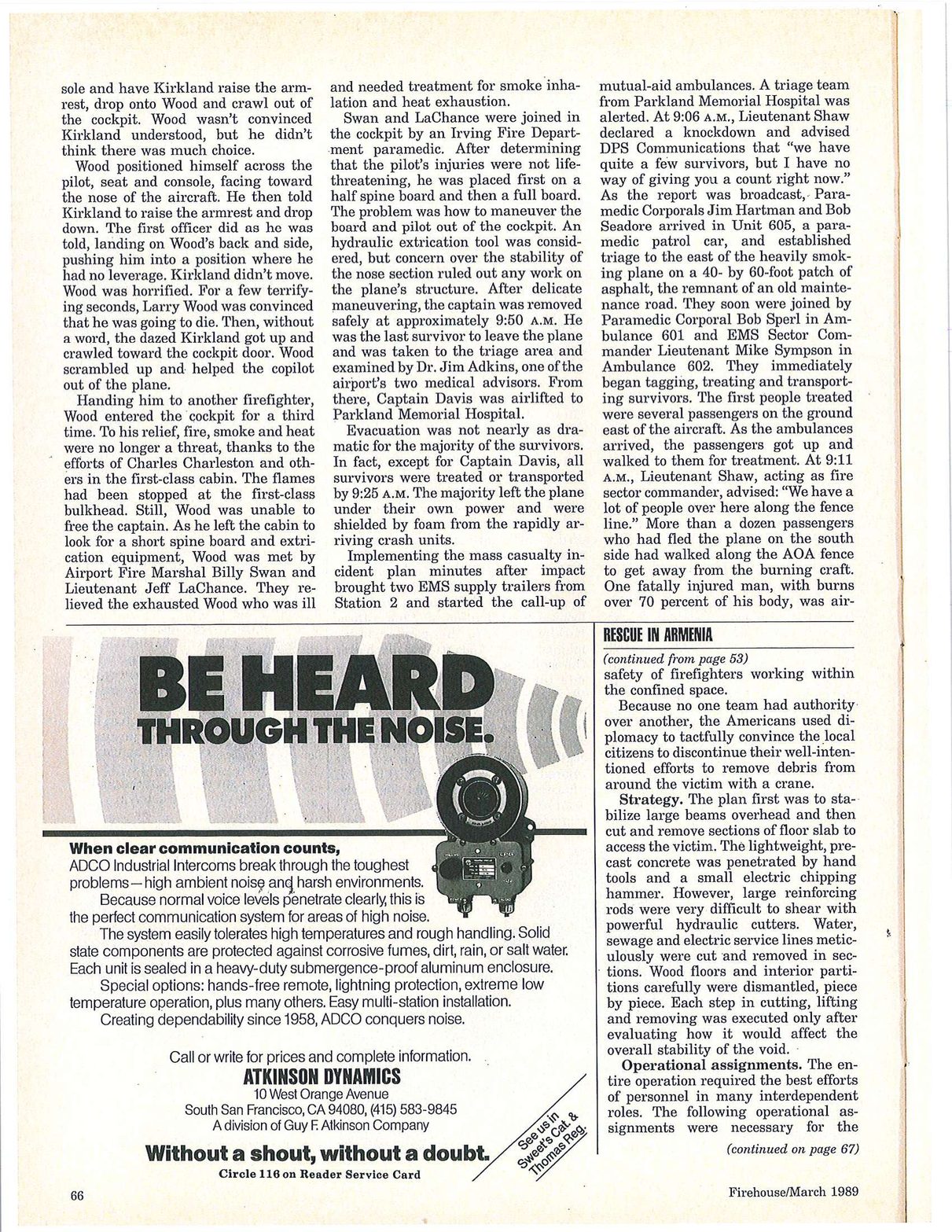
The rescue. The first step in the operation was surveying the entire scene and assessing the effects on building stability by the vibrations of traffic and heavy equipment nearby. Of particular importance were actions by the local citizens with heavy equipment prior to the arrival of the American team and how it would affect the safety of firefighters working within the confined space.
Because no one team had authority over another, the Americans used diplomacy to tactfully convince the local citizens to discontinue their well-intentioned efforts to remove debris from around the victim with a crane.
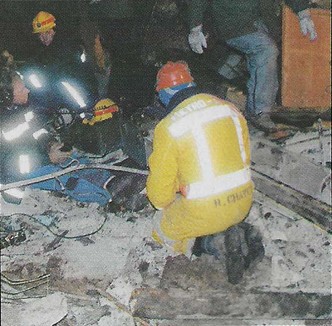
Strategy. The plan first was to stabilize large beams overhead and then cut and remove sections of floor slab to access the victim. The lightweight, precast concrete was penetrated by hand tools and a small electric chipping hammer. However, large reinforcing rods were very difficult to shear with powerful hydraulic cutters. Water, sewage and electric service lines meticulously were cut and removed in sections. Wood floors and interior partitions carefully were dismantled, piece by piece. Each step in cutting, lifting and removing was executed only after evaluating how it would affect the overall stability of the void.
Operational assignments. The entire operation required the best efforts of personnel in many interdependent roles. The following operational assignments were necessary for the safety of the victim and rescuers.
- Incident Commander (IC). Control and coordinate all personnel and functions at the scene. Lieutenant Chavez evaluated the effectiveness of his strategy and made revisions as conditions changed and more information became available as the victim was accessed.
- Command Aid. Monitor radio and relay information to and from the IC.
- Paramedic. Monitor the victim’s condition throughout the operation and observe the effect of cutting and lifting structural components.
- Safety Officer and Observers. Observe each step in the operation and how it affects the safety of the rescuers and victim; can override the IC on issues involving safety; post assistants as observers in strategic locations at the scene to observe any movement of the structure, vibrations by heavy equipment and any uncontrolled acts by local citizens. At one scene, they stopped a bulldozer from removing debris while firefighters were in a void.
- Tool Operators. Operate hand and power tools.
- Power Unit Operators. Connect sufficient hydraulic hose and electric cables to permit hydraulic pumps and generators to be run outside the immediate rescue area; run and refuel power equipment; and provide lighting.
- Physicians. Stood by to treat victims and rescuers; amputated the legs of one of the deceased children to expedite the removal of the elderly victim.
Close-in work. Following the cutting and removal of obstacles, firefighters “bellied in” to the narrow void and began the slow and arduous task of removing rubble from around the victim. A human chain was formed to pass debris from hand to hand. Firefighters spent hours on their backs or sides, digging by hand most of the rubble trapping the woman.
The digging and removal operation had progressed to the point where it was thought that the only obstacle to the victim’s release were the bodies of an infant and a teenage girl who had died in the woman’s arms. Firefighters began the grim task of wrestling the dead children free from the victim. At one point, they were stymied in their efforts to remove the deceased girl and called on Dr. Jim Dugal to amputate her legs, which cleared the way for her release. Firefighters passed the decaying bodies over their heads to remove them from the void.
Shoring the structure. Only after the removal of the bodies could rescuers get a good look at the victim below the neck. It was apparent that she was a large woman and would require additional space and physical effort to remove. A substantial wooden door frame prevented her removal without manipulation of her fractures; however, it probably saved her life by supporting the floor slab above. Screw jacks were placed to provide shoring to the slab before the door frame was cut by an hydraulic cutter and removed. With the removal of this final obstacle, the attending paramedic, Lieutenant Carlos Castillo, repositioned her legs to allow her to be pulled to safety.
Within an hour of the woman’s rescue, the team was summoned to another site nearby where a voice could be heard from beneath the rubble. Upon their arrival, they could see clearly a young girl in a void among several bodies, crushed between floor slabs. This, fortunately, turned out to be a much easier rescue for the exhausted firefighters. After the preliminary survey was completed and safety observers were in position, a firefighter was lowered headfirst into the void below while members held his ankles. After some minor debris removal and manipulation of the victim, she was pulled free in relatively good condition after being trapped for six days.
The following days were discouraging ones for team members as every search revealed only victims who could no longer survive. At this point, time was against the rescuers. There is no question they could have saved many lives if they had arrived sooner. Due to the diminishing chances of survival, the Americans concluded operations after five days of neither heat nor showers and very little sleep.
Critical incident stress debriefing. Team members returned to the United States and underwent a series of debriefings intended to reduce the stress or emotional trauma that can affect those who work among death and misery. The group sessions seemed to allay the feeling of helplessness that some experienced from not being able to save more lives.
Lessons learned, lessons reinforced
- Rotate personnel. Command and sector officers must look for signs of physical and/or mental fatigue among workers.
- Inside man. For every action of lifting, prying, cutting or digging, there is a reaction that can affect stability or harm the victim. An experienced firefighter or firemedic must remain with the victim to observe the effects of extrication and to ensure that the victim’s safety is not compromised.
- Safety officers. A safety officer and observers are vital to the overall safety of the victim and rescuers. Tool operation and disentanglement typically cause rescue personnel to experience an ever-narrowing case of tunnel vision and they may be oblivious to the unsafe acts of those around them.
- Technical advisor. No fire officer should rely entirely on his experience in dealing with a building collapse. Experts from the engineering and educational communities should be consulted on matters concerning building design, strengths and weaknesses and their behavior in a collapse.
- Fiber optics. Using fiber optic technology, develop and perfect a rugged and simple device that can be poked through a small hole to observe victims or conditions in a void.
- Protective clothing. Standard fire department turnout gear proved to be unsuitable and dangerous for confined space entry.
- Shovels. A simple, compact, army-type shovel proved to be very valuable in removing rubble from close in around victims.
Bill Gustin is a captain with the Metro-Dade County, Florida, Fire Department and an associate instructor at Miami-Dade Community College Fire Academy.
All photos in the article by Bill Gustin.
© 1989 Firehouse. Reprinted with permission.
The original pages
 Page 48
 Page 49
 Page 52
 Page 53
 Page 66
 Page 67
 Page 86
Scans of the March 1989 issue, courtesy of Firehouse. The same issue carried a sidebar by Jan Costley, “Seattle Firefighters Answer the Call to Armenia,” which is not reprinted here.
Photographs From the Deployment
Fairfax County Fire and Rescue’s team worked alongside the Metro-Dade crew throughout the mission. These photographs of the deployment come from Fairfax County’s own collection and were shared with the Gustin family in November 2026.
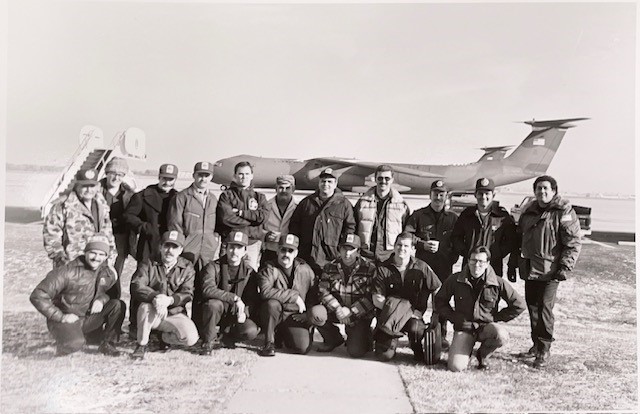
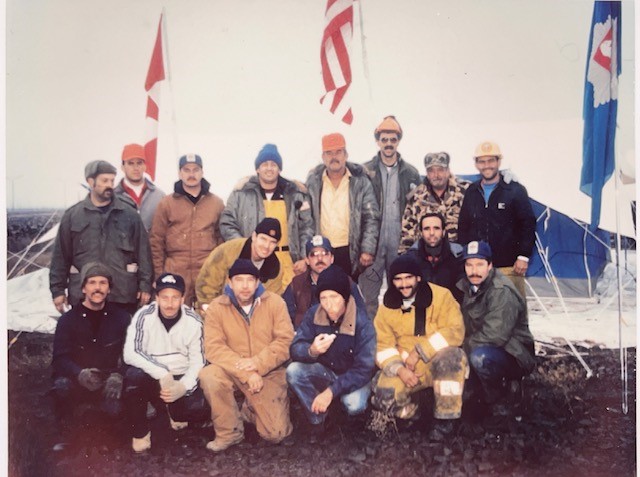
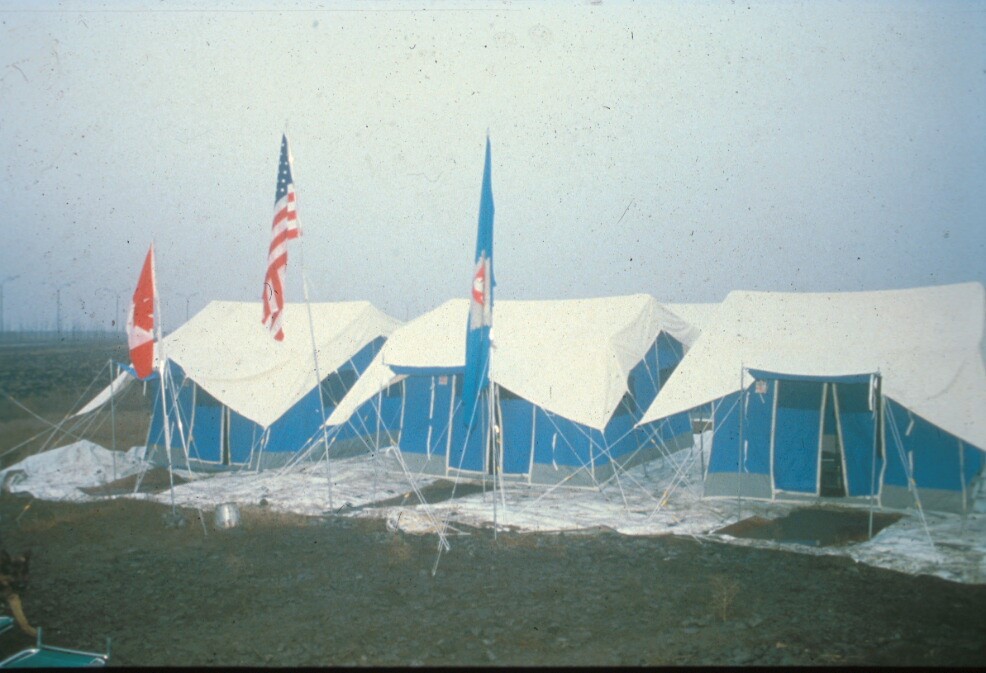
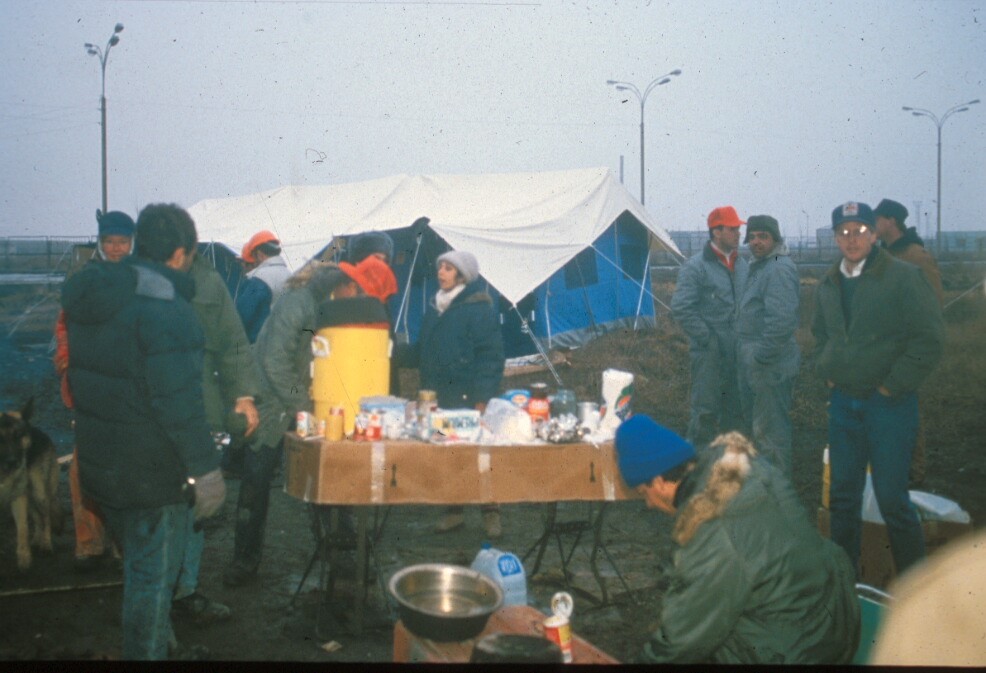
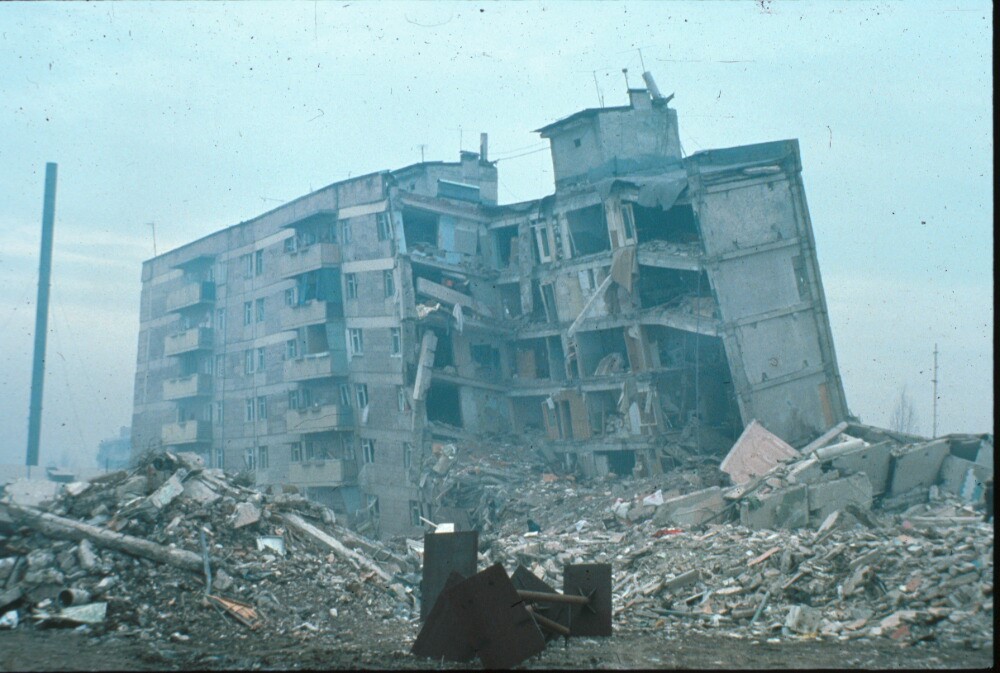
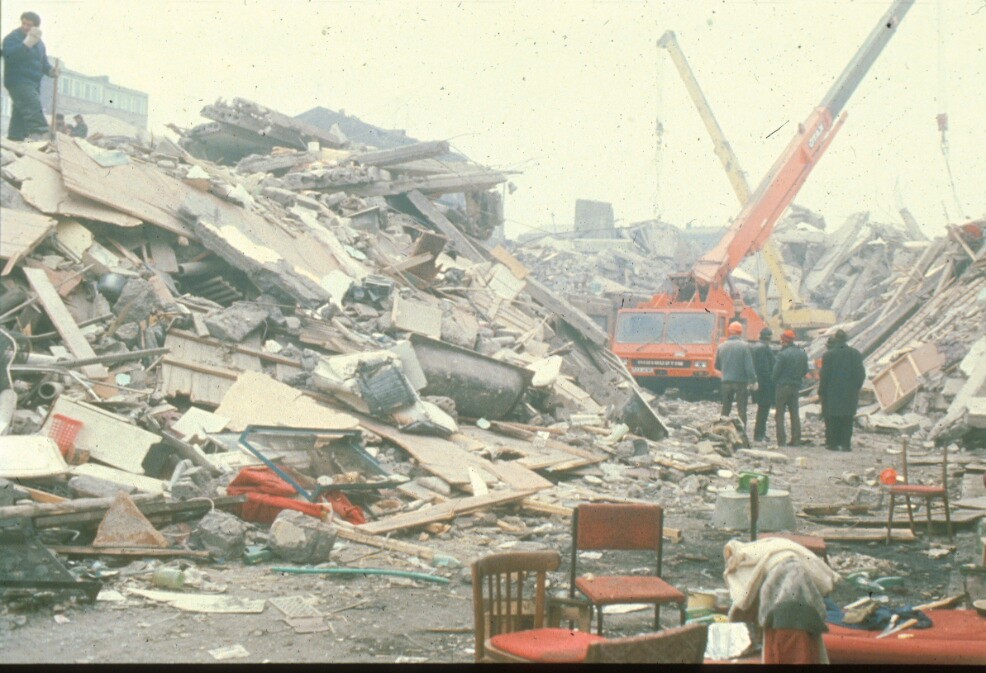
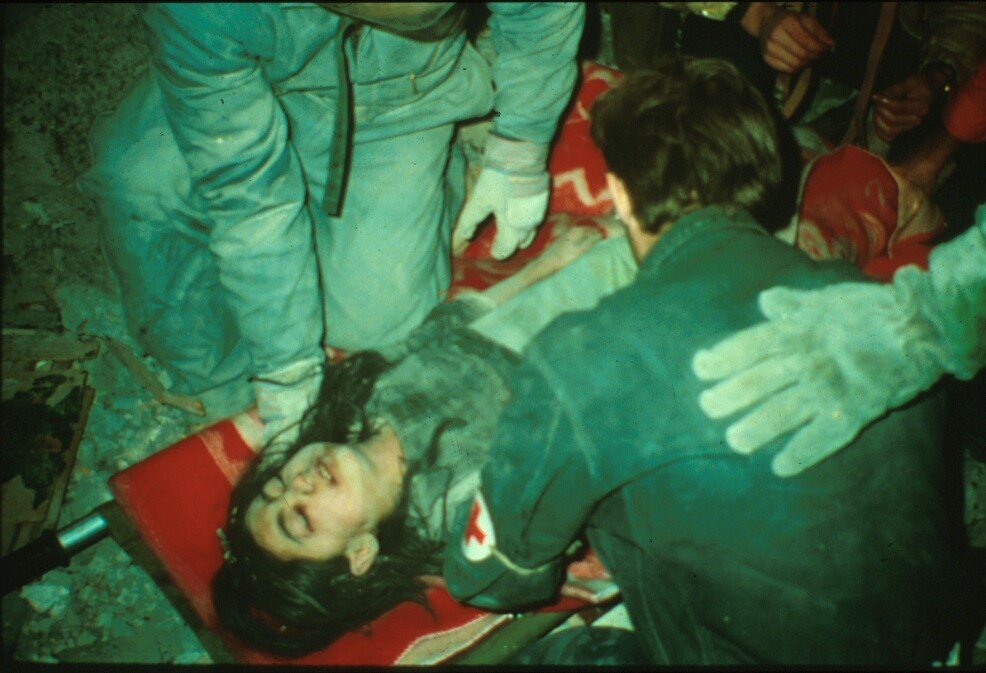
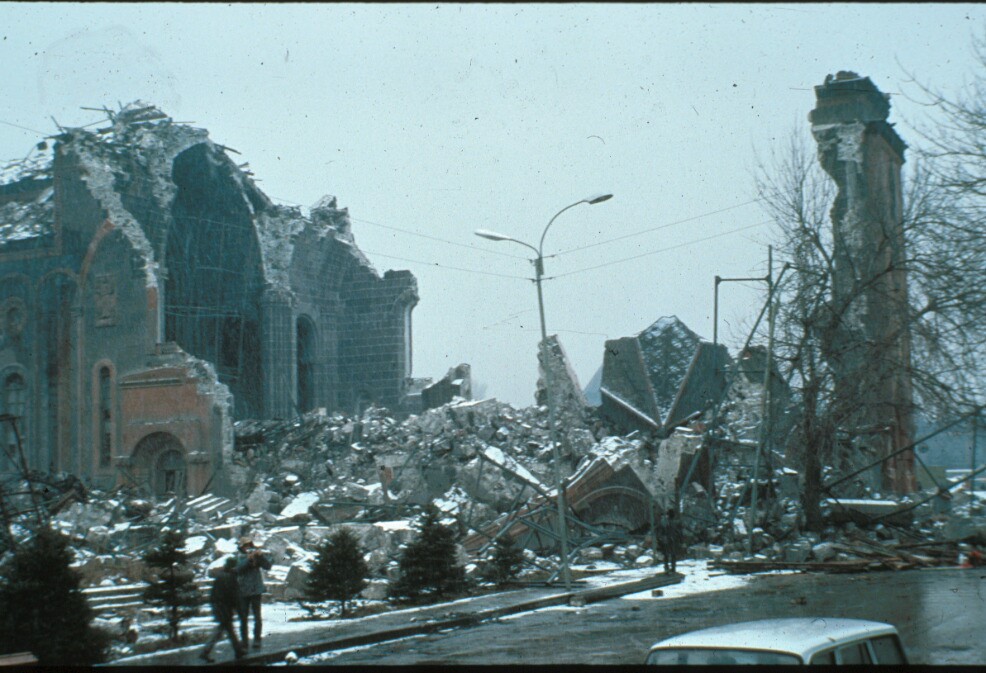
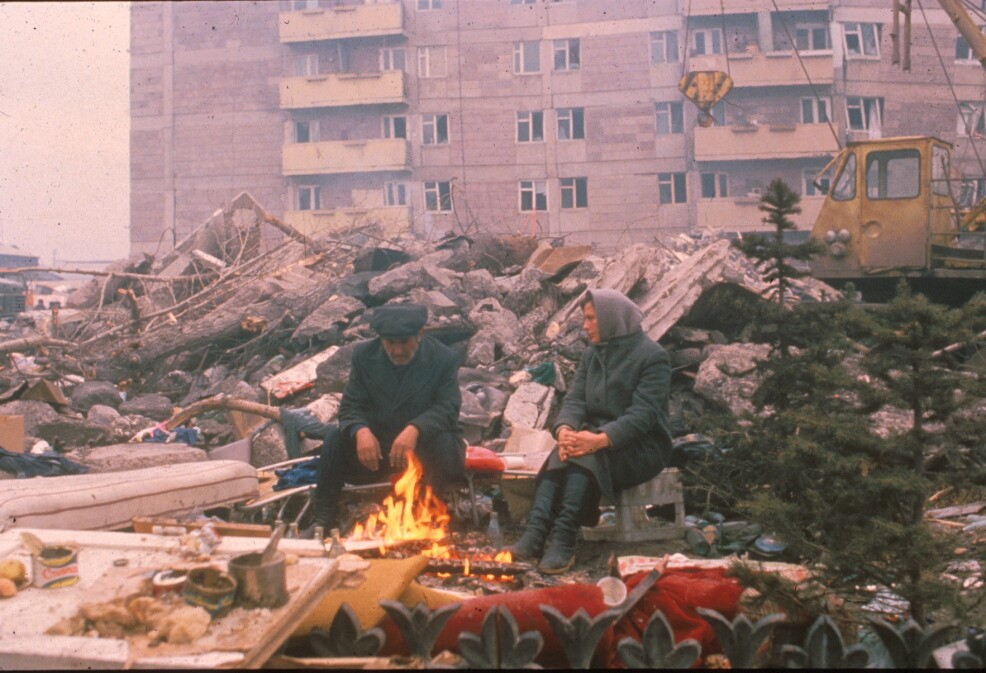
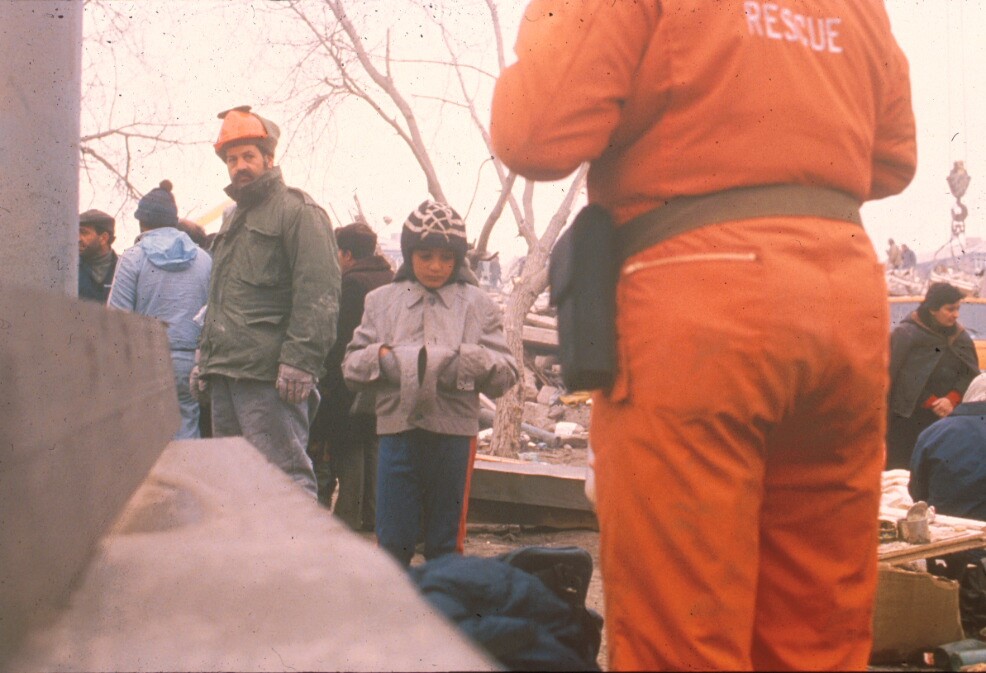
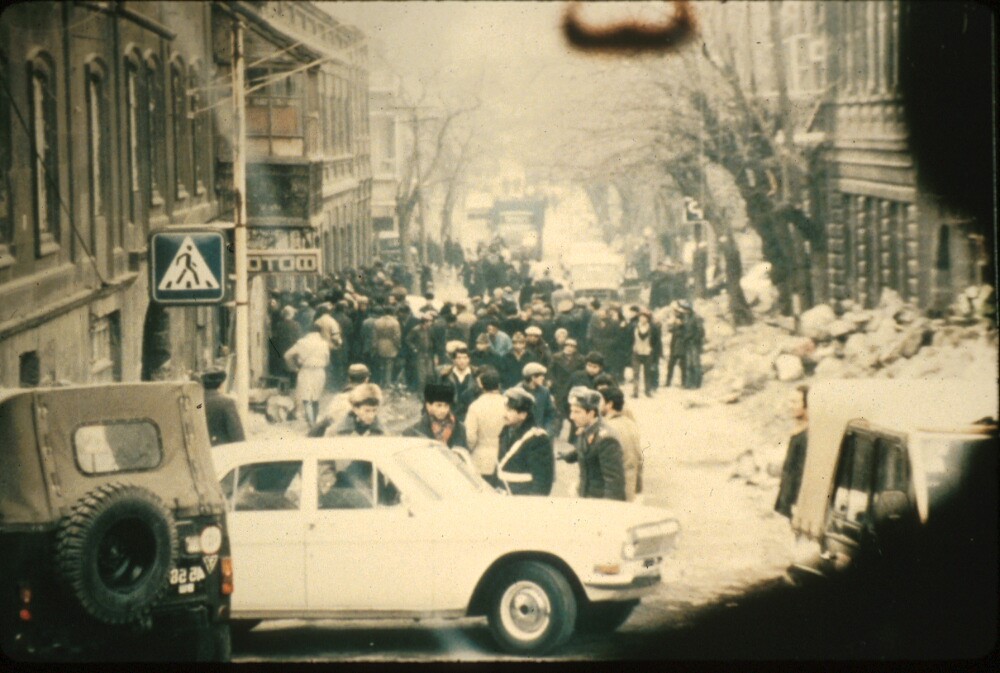
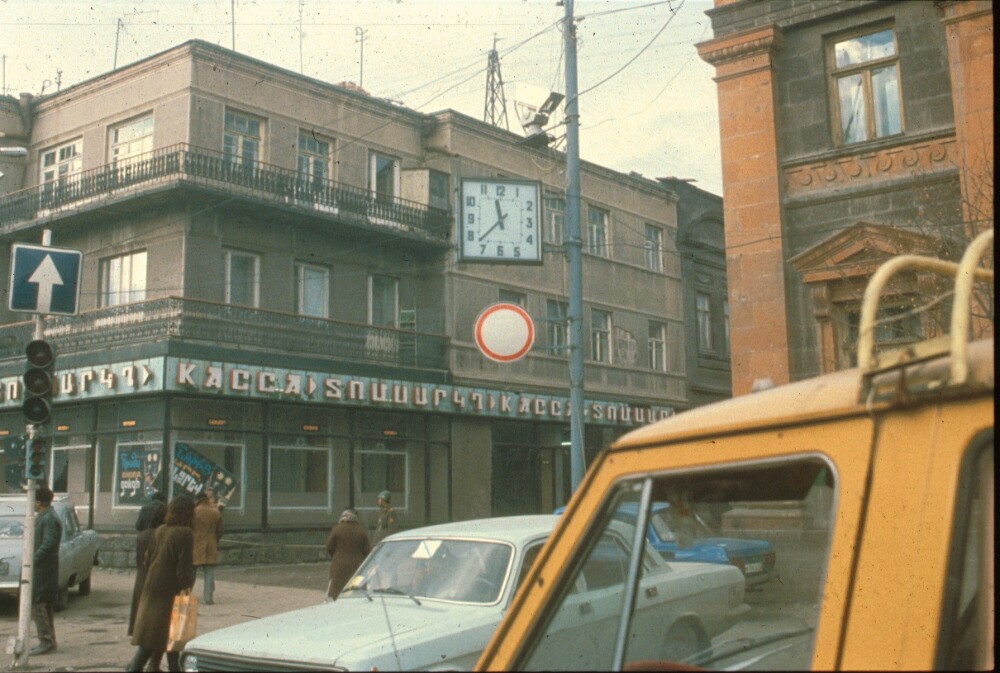
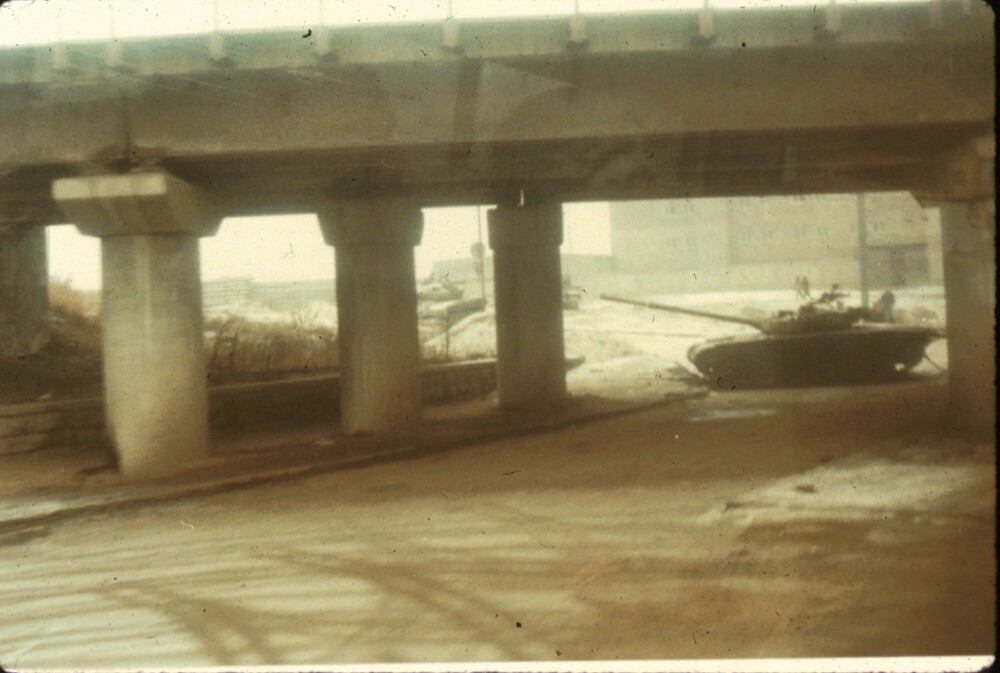
All photos courtesy of Fairfax County Fire and Rescue Department. Used with permission.
Home From Armenia
December 19, 1988
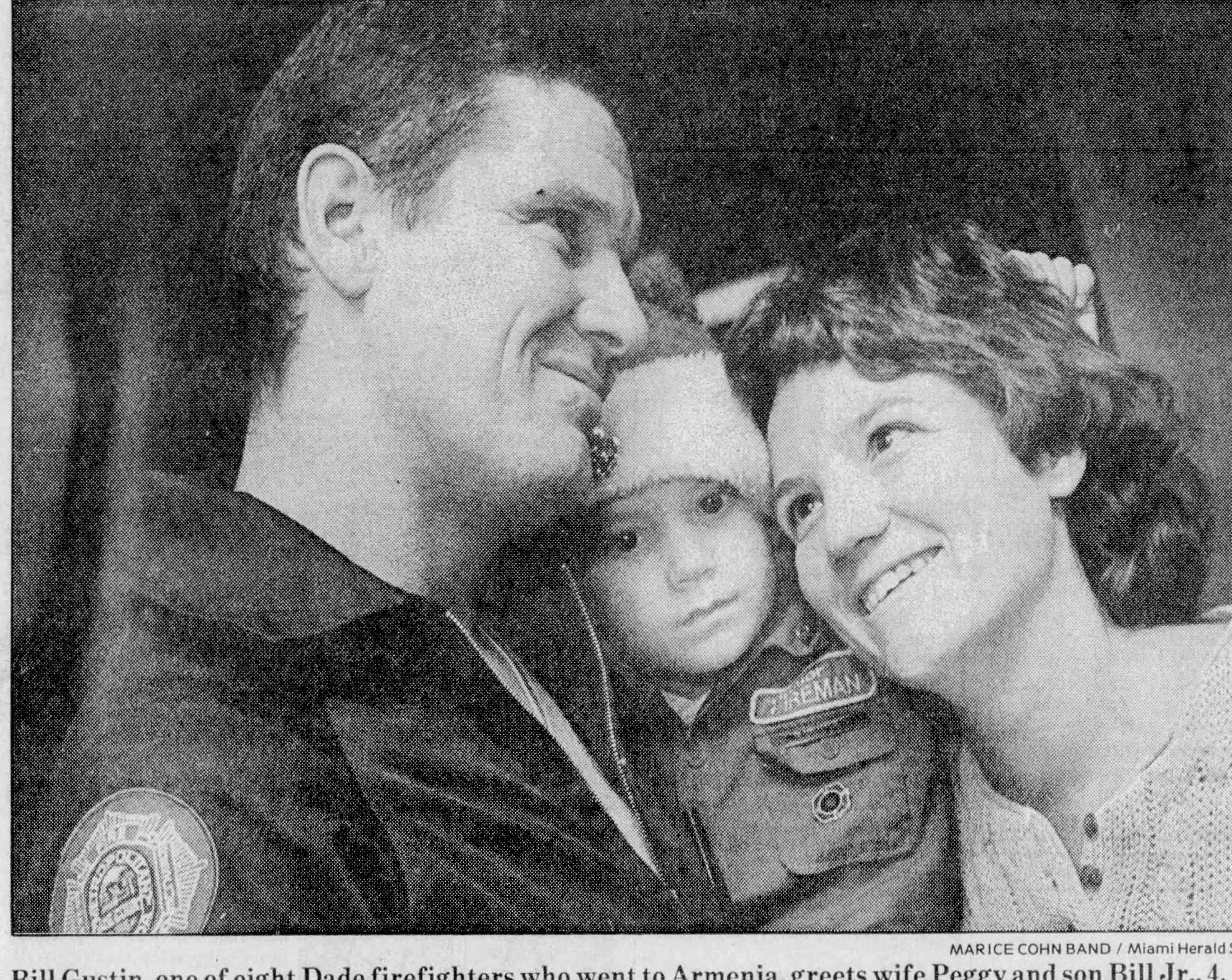
On December 18, 1988, Capt. Bill Gustin came home to Miami after six days searching the collapsed buildings of Leninakan, Armenia. The Herald’s photograph that day showed him greeting his wife, Peggy, and their son, Bill Jr.
Working beside a team from Fairfax, Virginia, Gustin and the Metro-Dade crew dug through the ruins of a city of 250,000. The day after they arrived, after hours of digging into a collapsed apartment building, they reached a woman who was still alive, holding her two children, who had not survived. They brought her out alive. Two years later he told the Herald it took seven hours, and that it was tough.
At the airport he described what he had seen: a region that looked like it was recovering from a nuclear holocaust, people walking in a daze, and a casket on every street corner. He said he was thankful to be home with his wife and son.
He also had advice for the Broward County paramedics leaving for Armenia that night. The work, he said, had moved from freeing people from the rubble to treating the injured, and the region was desperately short of doctors and medical care.
He told The Miami News that the team left almost everything it had brought, including blankets, sleeping bags and clothes, behind for the victims.
The buildings were reduced to ruins and the people were walking around in a daze. The Soviets had placed a casket on every street corner.Capt. Bill Gustin, to the Sun-Sentinel
It made me realize how lucky we are here.Capt. Bill Gustin
The original articles
Amid the rubble of Soviet Armenia, a team of Metro-Dade firefighters searching for earthquake survivors set up camp last week and raised the U.S. flag.
"The Russian soldiers saluted," said firefighter Doug Jewett, 46. "We walked the streets and everybody would stop us, hug us, kiss us and say, ’Amerikan, Amerikan.’ "
Carrying a Soviet soldier’s helmet, assorted military patches and other mementos of their six days in northern Armenia, eight haggard Metro firefighters ranging in age from 28 to 60 returned to Miami Sunday after a historic rescue mission.
Sponsored by the State Department’s Office of Foreign Disaster Assistance, the team joined the largest U.S. aid effort to the Soviet Union since World War II.
Together with a 10-member team from Fairfax, Va., the Dade rescuers spent most of their time in Leninakan, a city of 250,000 devastated by the Dec. 7 earthquake that killed an estimated 100,000 people.
"It was sort of a nightmarish atmosphere," said Chief Fire Officer Bill McIntyre, 39, the team’s only Russian speaker. "People would come up and grab us by the arms, and they would insist, ’Bring your team, I know where there are people.’ They would clutch at any straws."
For many, it was too late. Many who weren’t killed by falling debris died in the subfreezing temperatures, trapped in the rubble.
The Dade team landed Dec. 11. But the day after their arrival -- after five hours of digging through the ruins of an apartment building -- they found a woman with her arms wrapped around two dead children.
"She was conscious, but she was not really aware of what was going on around her," said Joaquin del Cueto, 34, a Metro lieutenant. He said the woman’s legs had to be amputated.
Del Cueto and three other team members -- Jewett and Lts. Jimmy Arias, 60, and Raul Chavez, 36 -- are veterans of such rescue efforts; all were in Mexico City following the massive September 1985 earthquake.
In Leninakan, the rescue team described tragic, chilling scenes: empty coffins; darkened streets where the homeless kept warm around makeshift fires; desperate people who swore they could still hear their relatives’ voices calling out to them from the rubble.
"The more experienced people would tell us: ’They hear voices because they want to hear voices,’ " said McIntyre, who studied Russian in college but had never visited the Soviet Union before the rescue trip.
As the Dade rescue workers recounted their experiences, a group of 11 Broward paramedics prepared Sunday night to take off for Armenia aboard a plane provided by Sarkis Soghanalian, a Miami weapons dealer of Armenian descent.
"I think they’ll have plenty to do," said Capt. Bill Gustin. "They’ve gone from the stage of releasing the people from the rubble to actually treating people who are injured. They’re desperately lacking in physicians and adequate medical care."
The Dade team -- one of several rescue groups from around the world -- had kind words for the Soviet soldiers monitoring the rescue efforts.
"When we needed gasoline for our generators, they would siphon it out of the tanks of their vehicles and give it to us," McIntyre said.
Camped in the outskirts of Leninakan, the Dade team members shared their tents with Canadian rescuers who arrived without tents. They shared food with a team of nurses and doctors from Cuba.
"We talked about drinking, we talked about women," said Jewett, who was born in Cuba and speaks fluent Spanish. "We didn’t get into politics."
Original photo caption: Bill Gustin greets his wife Peggy and son Bill Jr.
© 1988 The Miami Herald. Reprinted with permission.
Entre los escombros en la Armenia sovietica, un escuadron de bomberos del condado de Dade que colaboro en la tarea de buscar sobrevivientes del terremoto, levanto su campamento la semana pasada y coloco la bandera norteamericana.
"Los soldados rusos saludaron la bandera", dijo el bombero Doug Jewett, de 46 anos. "Caminabamos por las calles de la ciudad y todos nos paraban, nos abrazaban, besaban y decian: ’amerikan, amerikan’. . .".
El grupo de rescate de Dade estaba acampado en las afueras de Leninakan y compartieron sus tiendas de campanas con el equipo de rescate canadiense que llego sin ellas. Tambien compartieron alimentos con un grupo de medicos y enfermeras cubanos. "Hablamos de bebidas, hablamos de mujeres", dijo Jewett que nacio en Cuba y habla espanol con fluidez, "pero nunca hablamos de politica".
Al llegar, portaban cascos de soldados sovieticos, diversas insignias militares y otros recuerdos de sus seis dias de permanencia en la zona norte de Armenia. Ocho demacrados bomberos del cuerpo metropolitano, que oscilan entre los 28 y los 60 anos, regresaron el domingo a Miami despues de participar en una historica mision de socorro.
El grupo patrocinado por la Oficina de Asistencia de Desastres en el Extranjero del Departamento de Estado, se unio al mayor esfuerzo de ayuda que Estados Unidos ha brindado a la Union de Republicas Socialistas Sovieticas (URSS) desde la Segunda Guerra Mundial.
Junto con un grupo integrado por 10 miembros procedentes de Fairfax, Virginia, el grupo de rescate de Dade paso la mayor parte del tiempo en Leninakan, ciudad con una poblacion de 250,000 que fue devastada por el terremoto del 7 de diciembre, en el cual perecieron aproximadamente 100,00 personas.
"Habia una especie de atmosfera de pesadilla", expreso Bill McIntyre, de 39 anos, la unica persona en el grupo que habla ruso. "La gente se nos acercaba y nos sujetaba por los brazos , e insistia: ’Traiga a su gente; yo se donde hay mas personas’. Se aferraban a cualquier pequeno indicio".
Para muchos, ya era demasiado tarde. Algunos que no perecieron a causa de los derrumbes sucumbieron a las temperaturas bajo el nivel de congelacion, atrapadas debajo de los escombros.
El escuadron de rescate de Dade --uno de varios grupos de rescate de todo el mundo-- tuvo palabras afectuosas para los soldados sovieticos que estan participando en las labores de rescate.
Original photo caption: Bill GUSTIN del grupo de bomberos de Dade que fue a Armenia con su esposa Peggy y su hijo Bill Jr
© 1988 El Nuevo Herald. Reprinted with permission.
This article is summarized above and is not reprinted here.
Also reported in The Miami News, December 19 and 21, 1988; Fort Lauderdale News, December 19, 1988.
Honored at the White House
December 22, 1988
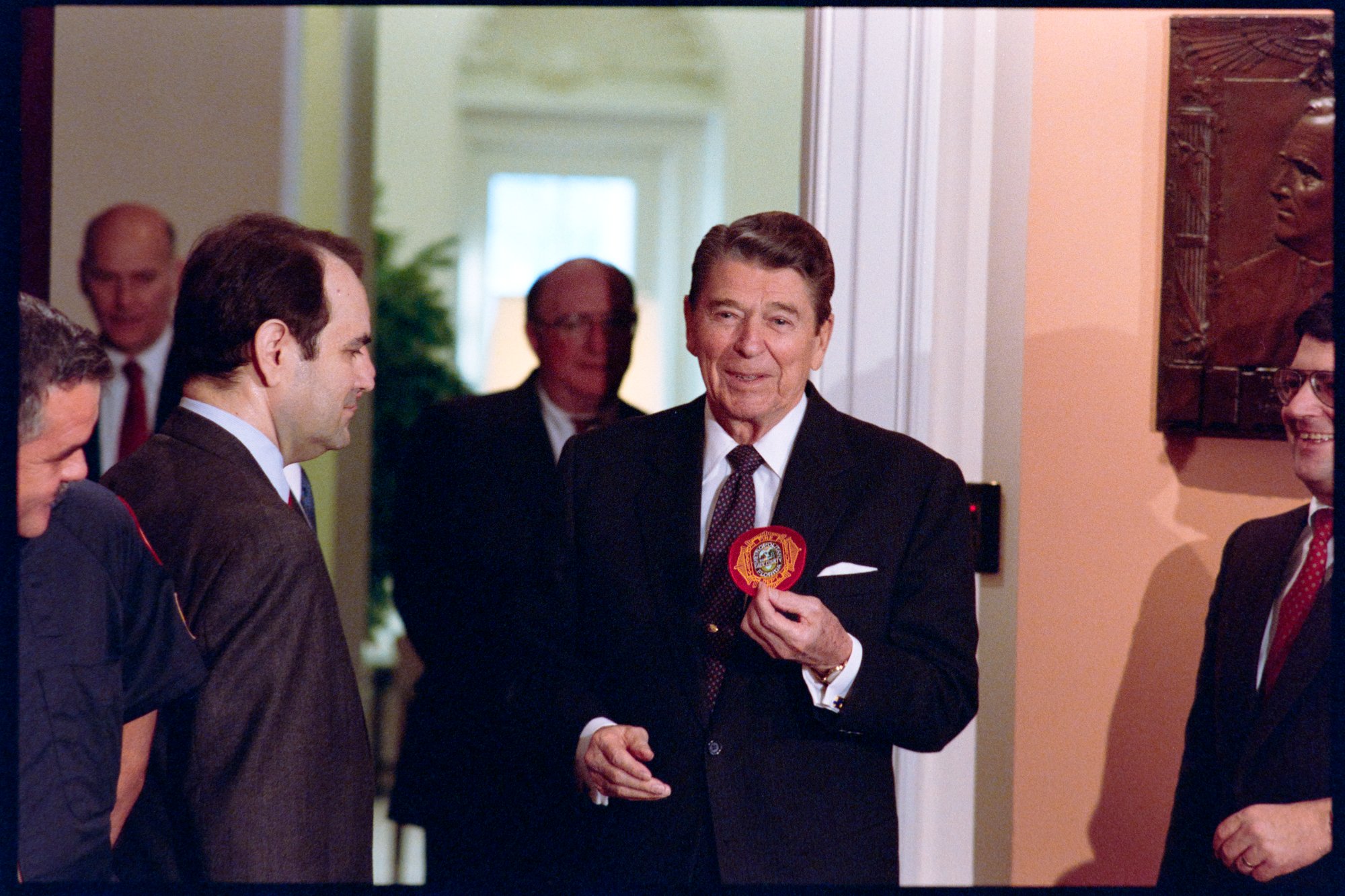
On December 22, 1988, Capt. William Gustin and the seven other members of Metro-Dade’s Armenia rescue team were honored at the White House. They met President Ronald Reagan that morning, followed by a reception in their honor.
The team had spent a week searching for survivors in Leninakan after the December 7 earthquake, which killed an estimated 100,000 people, working at the request of the U.S. Agency for International Development’s Office of Foreign Disaster Assistance.
The State Department also recognized the team. The Herald reported on December 23 that William Gustin and his Metro-Dade teammates were among the U.S. rescuers who received certificates of praise from the State Department.
When Dade County’s mayor honored him two years later as Florida’s Firefighter of the Year, the Herald again noted that he had been honored by President Reagan for his rescue work in Armenia.
The original article
Excerpt from the Herald’s In Brief column.
Eight Metro-Dade firefighters who helped victims of earthquake in Soviet Armenia will be honored at the White House today.
Chief William McIntyre, Capt. William Gustin, Lts. Joaquin del Cueto, Carlos Castillo, Raul Chavez and James Arias, firefighter Allester Jewett and team coordinator Douglas Jewett will meet with President Reagan this morning, followed by a reception in their honor.
The firefighters spent a week in the city of Leninakan, searching for survivors of the Dec. 7 earthquake that killed an estimated 100,000 people. The firefighters went at the request of the Office of Foreign Assistance, an arm of the Agency for International Development.
© 1988 The Miami Herald. Reprinted with permission.