The Philippines, 1990
July – December 1990
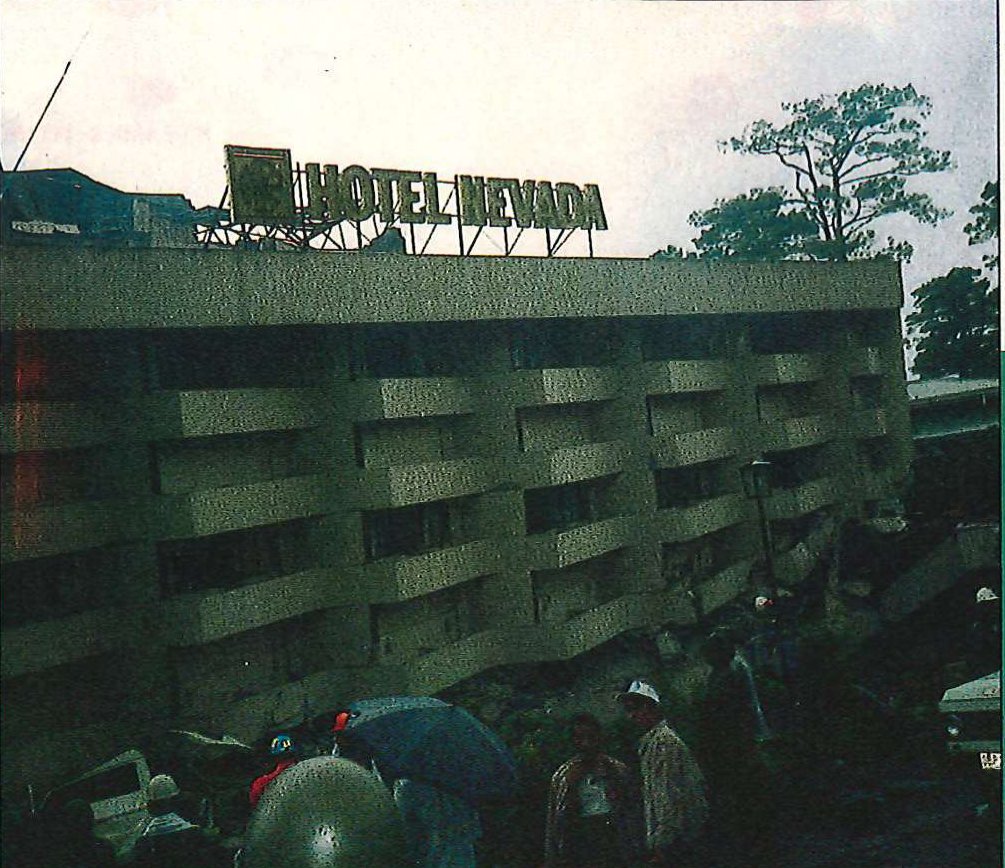
In July 1990, less than two years after Armenia, Captain Gustin deployed overseas again with Metro-Dade’s Special Disaster Response Team, this time to the earthquake that struck Luzon in the Philippines.
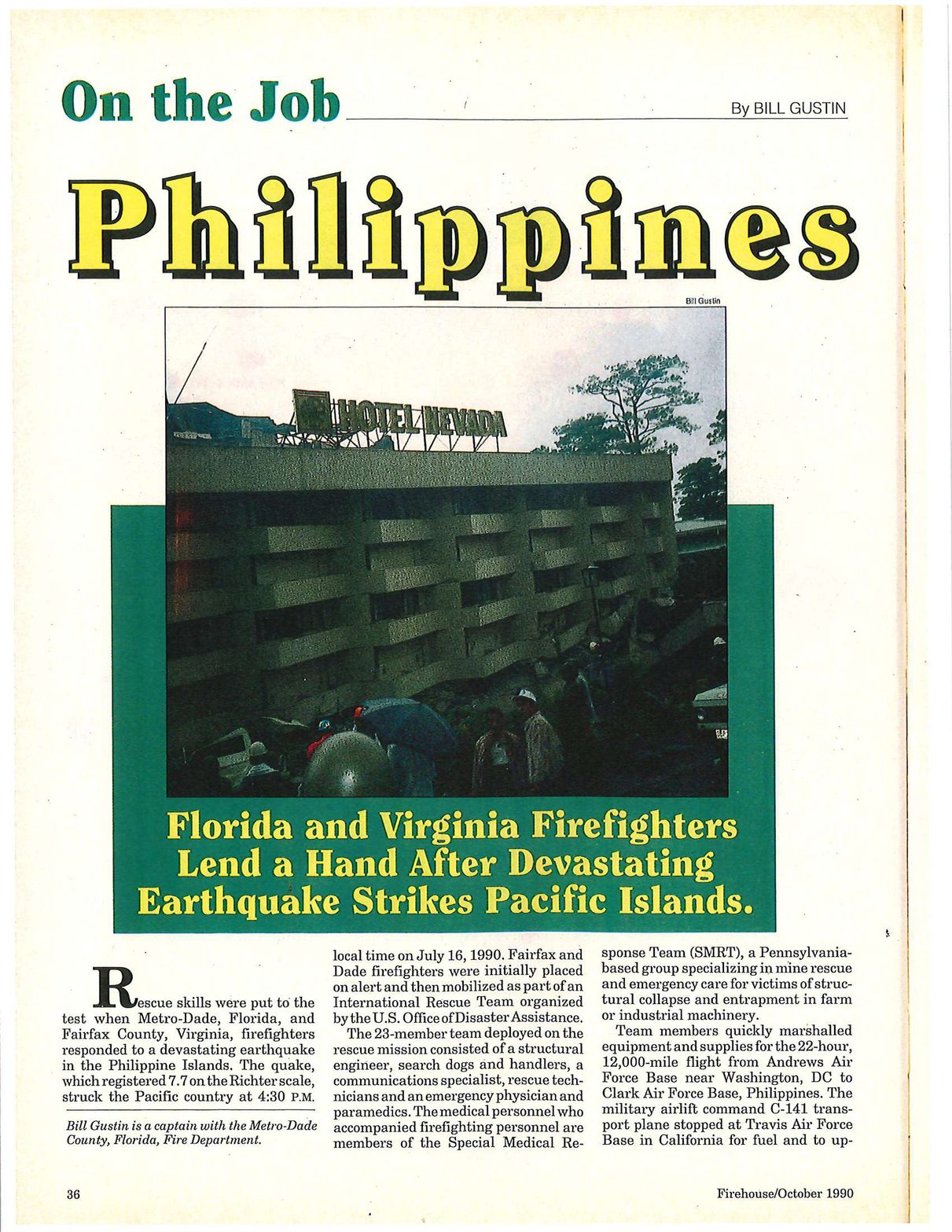
The magnitude 7.7 earthquake of July 16, 1990, brought down buildings across northern Luzon. A 23-member U.S. team of Metro-Dade and Fairfax County firefighters, with a rescue medical team from Pennsylvania, flew in on a military transport and was taken by helicopter to the mountain city of Baguio, where it spent two days at the collapsed Hotel Nevada. As in Armenia, he wrote the story of the mission for Firehouse magazine and took most of the photographs that ran with it.
On this pageIn his wordsHonored for the rescueSources
In His Words: “On the Job: Philippines”
Firehouse magazine · October 1990
Three months after the earthquake, Captain Gustin wrote the story of the Philippines mission for Firehouse magazine, illustrated with photographs he took inside the Hotel Nevada.
His article explains how the Americans won over the local gold miners who were already tunneling up from the basement, why they chose to work down from the third floor instead, and the nine hours it took to free a man pinned by a concrete beam in a second-floor conference room. He closed with the point he made about every international mission: the job is to support local rescuers, not to take over.
The original article
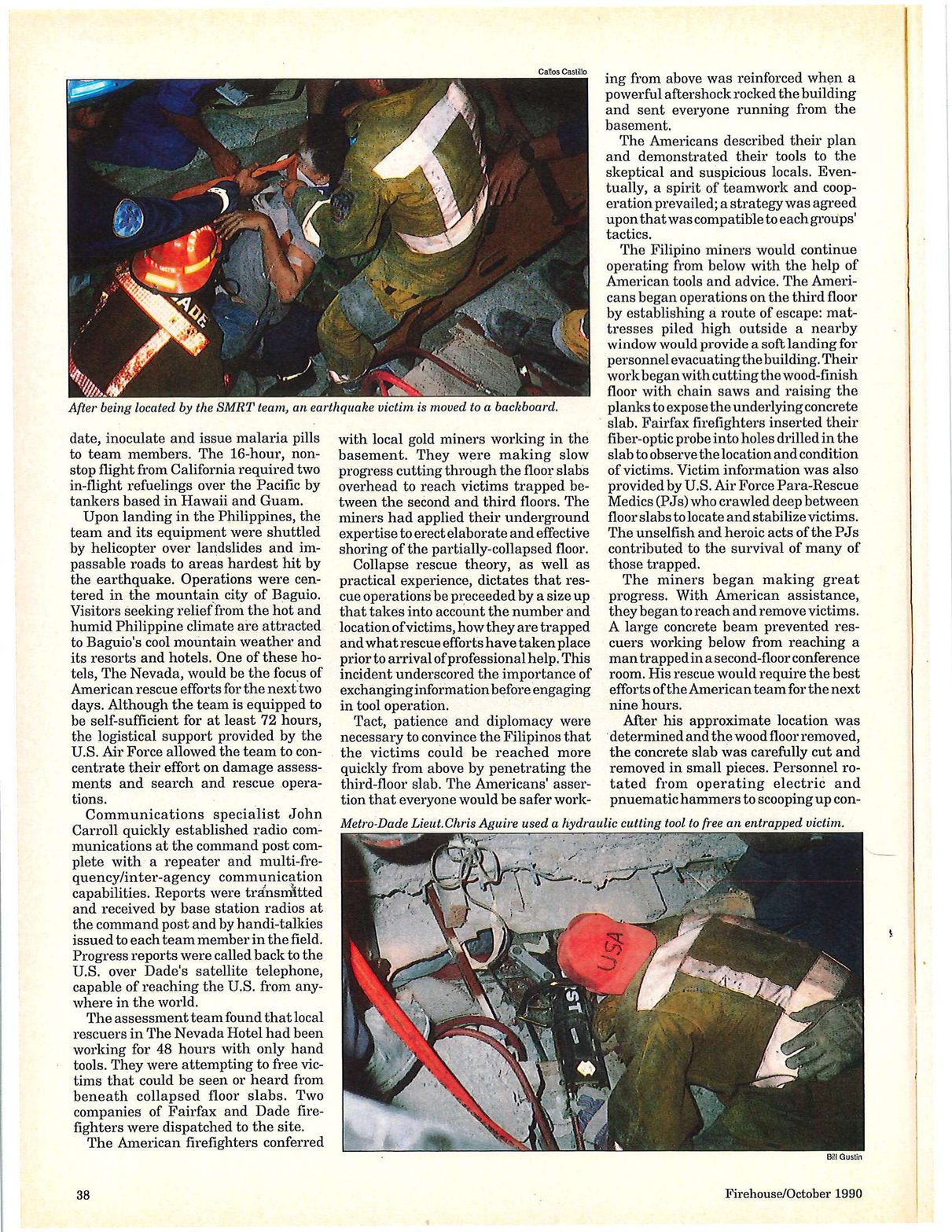
Rescue skills were put to the test when Metro-Dade, Florida, and Fairfax County, Virginia, firefighters responded to a devastating earthquake in the Philippine Islands. The quake, which registered 7.7 on the Richter scale, struck the Pacific country at 4:30 p.m. local time on July 16, 1990. Fairfax and Dade firefighters were initially placed on alert and then mobilized as part of an International Rescue Team organized by the U.S. Office of Disaster Assistance.
The 23-member team deployed on the rescue mission consisted of a structural engineer, search dogs and handlers, a communications specialist, rescue technicians and an emergency physician and paramedics. The medical personnel who accompanied firefighting personnel are members of the Special Medical Response Team (SMRT), a Pennsylvania-based group specializing in mine rescue and emergency care for victims of structural collapse and entrapment in farm or industrial machinery.
Team members quickly marshalled equipment and supplies for the 22-hour, 12,000-mile flight from Andrews Air Force Base near Washington, DC to Clark Air Force Base, Philippines. The military airlift command C-141 transport plane stopped at Travis Air Force Base in California for fuel and to update, inoculate and issue malaria pills to team members. The 16-hour, non-stop flight from California required two in-flight refuelings over the Pacific by tankers based in Hawaii and Guam.
Upon landing in the Philippines, the team and its equipment were shuttled by helicopter over landslides and impassable roads to areas hardest hit by the earthquake. Operations were centered in the mountain city of Baguio. Visitors seeking relief from the hot and humid Philippine climate are attracted to Baguio’s cool mountain weather and its resorts and hotels. One of these hotels, The Nevada, would be the focus of American rescue efforts for the next two days. Although the team is equipped to be self-sufficient for at least 72 hours, the logistical support provided by the U.S. Air Force allowed the team to concentrate their effort on damage assessments and search and rescue operations.
Communications specialist John Carroll quickly established radio communications at the command post complete with a repeater and multi-frequency/inter-agency communication capabilities. Reports were transmitted and received by base station radios at the command post and by handi-talkies issued to each team member in the field. Progress reports were called back to the U.S. over Dade’s satellite telephone, capable of reaching the U.S. from anywhere in the world.
The assessment team found that local rescuers in The Nevada Hotel had been working for 48 hours with only hand tools. They were attempting to free victims that could be seen or heard from beneath collapsed floor slabs. Two companies of Fairfax and Dade firefighters were dispatched to the site.
The American firefighters conferred with local gold miners working in the basement. They were making slow progress cutting through the floor slabs overhead to reach victims trapped between the second and third floors. The miners had applied their underground expertise to erect elaborate and effective shoring of the partially-collapsed floor.
Collapse rescue theory, as well as practical experience, dictates that rescue operations be preceeded by a size up that takes into account the number and location of victims, how they are trapped and what rescue efforts have taken place prior to arrival of professional help. This incident underscored the importance of exchanging information before engaging in tool operation.
Tact, patience and diplomacy were necessary to convince the Filipinos that the victims could be reached more quickly from above by penetrating the third-floor slab. The Americans’ assertion that everyone would be safer working from above was reinforced when a powerful aftershock rocked the building and sent everyone running from the basement.
The Americans described their plan and demonstrated their tools to the skeptical and suspicious locals. Eventually, a spirit of teamwork and cooperation prevailed; a strategy was agreed upon that was compatible to each groups’ tactics.
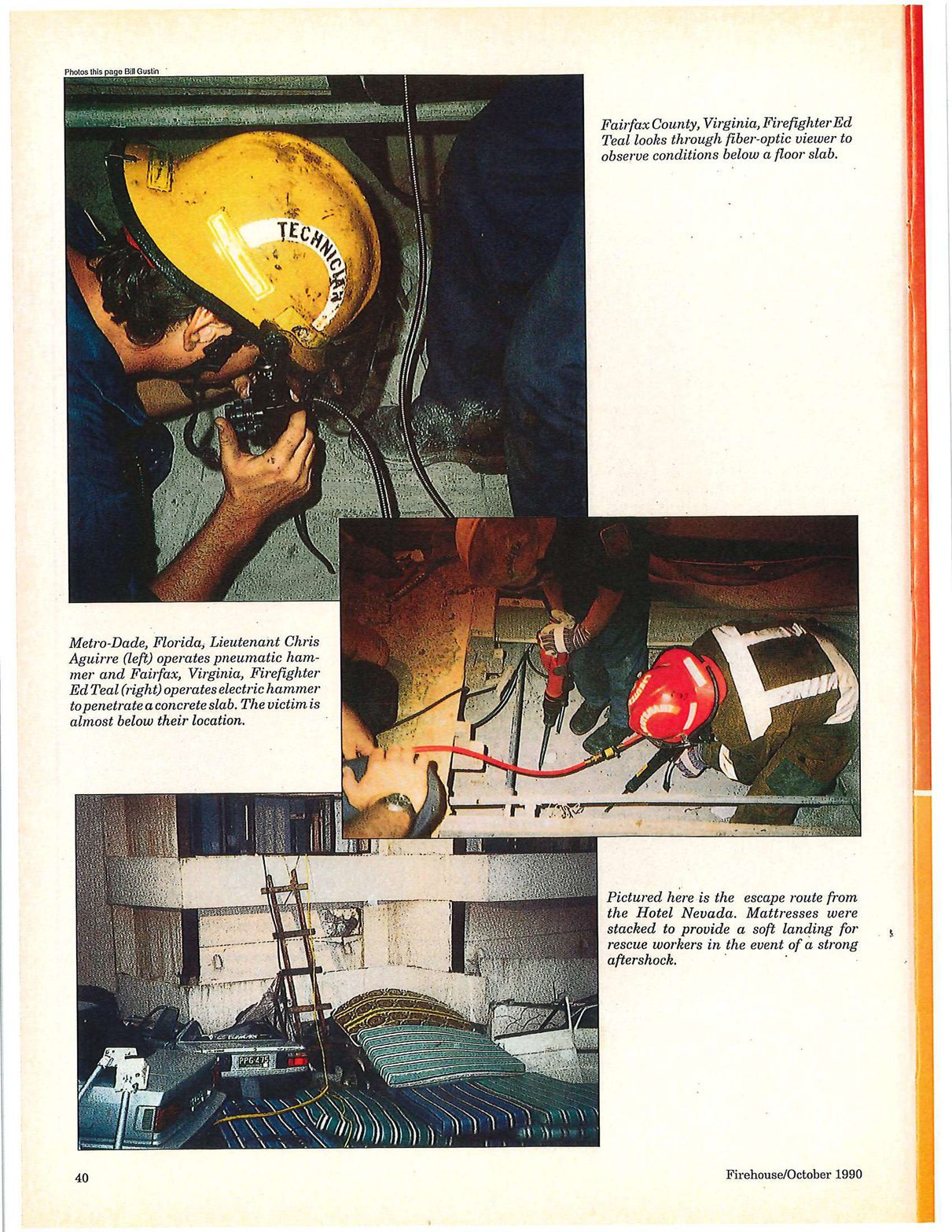
The Filipino miners would continue operating from below with the help of American tools and advice. The Americans began operations on the third floor by establishing a route of escape: mattresses piled high outside a nearby window would provide a soft landing for personnel evacuating the building. Their work began with cutting the wood-finish floor with chain saws and raising the planks to expose the underlying concrete slab. Fairfax firefighters inserted their fiber-optic probe into holes drilled in the slab to observe the location and condition of victims. Victim information was also provided by U.S. Air Force Para-Rescue Medics (PJs) who crawled deep between floor slabs to locate and stabilize victims. The unselfish and heroic acts of the PJs contributed to the survival of many of those trapped.
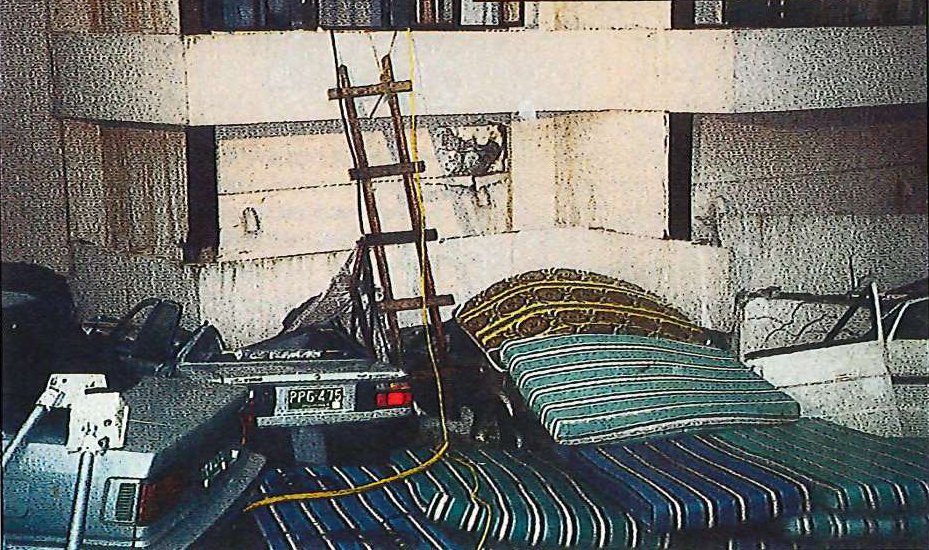
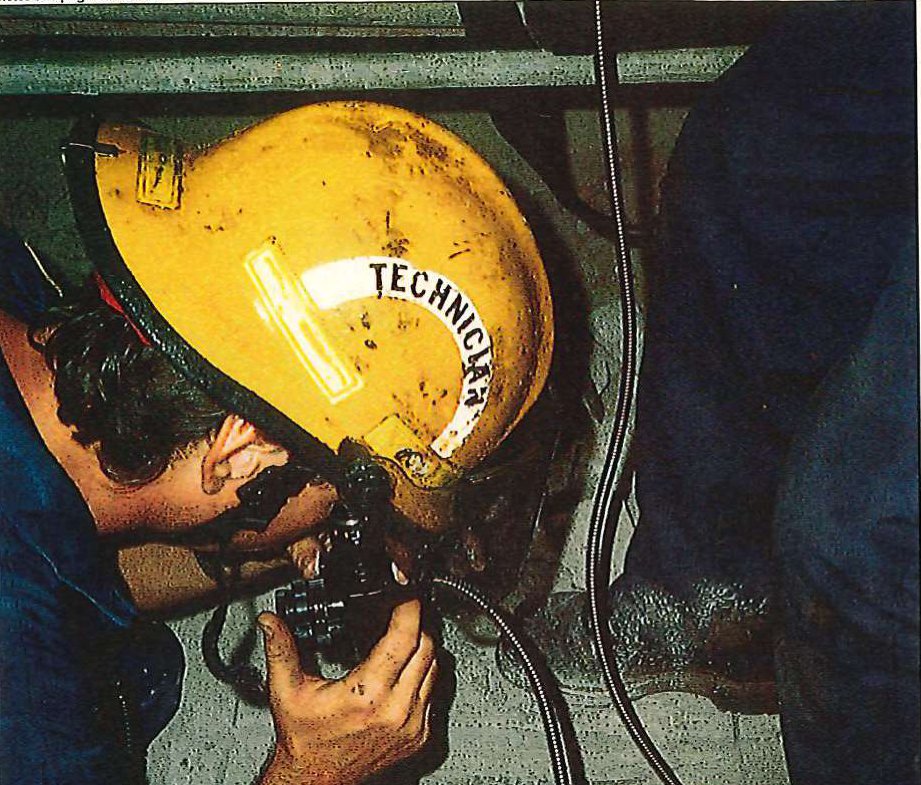
The miners began making great progress. With American assistance, they began to reach and remove victims. A large concrete beam prevented rescuers working below from reaching a man trapped in a second-floor conference room. His rescue would require the best efforts of the American team for the next nine hours.
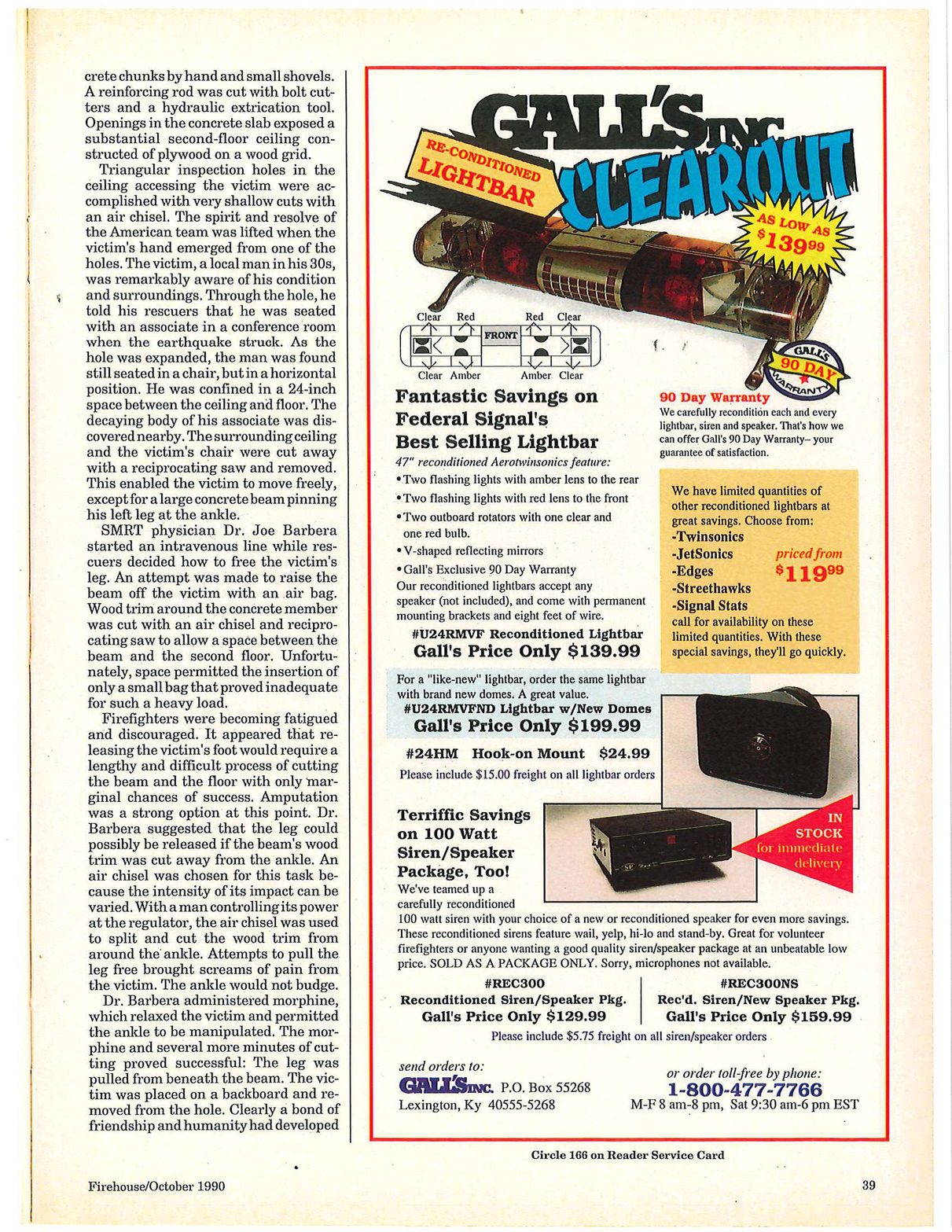
After his approximate location was determined and the wood floor removed, the concrete slab was carefully cut and removed in small pieces. Personnel rotated from operating electric and pnuematic hammers to scooping up concrete chunks by hand and small shovels. A reinforcing rod was cut with bolt cutters and a hydraulic extrication tool. Openings in the concrete slab exposed a substantial second-floor ceiling constructed of plywood on a wood grid.
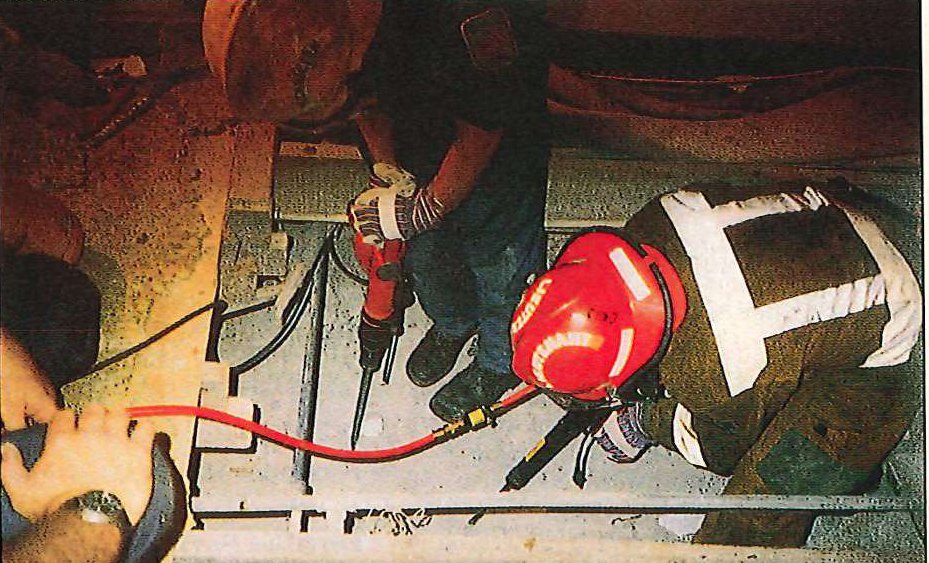
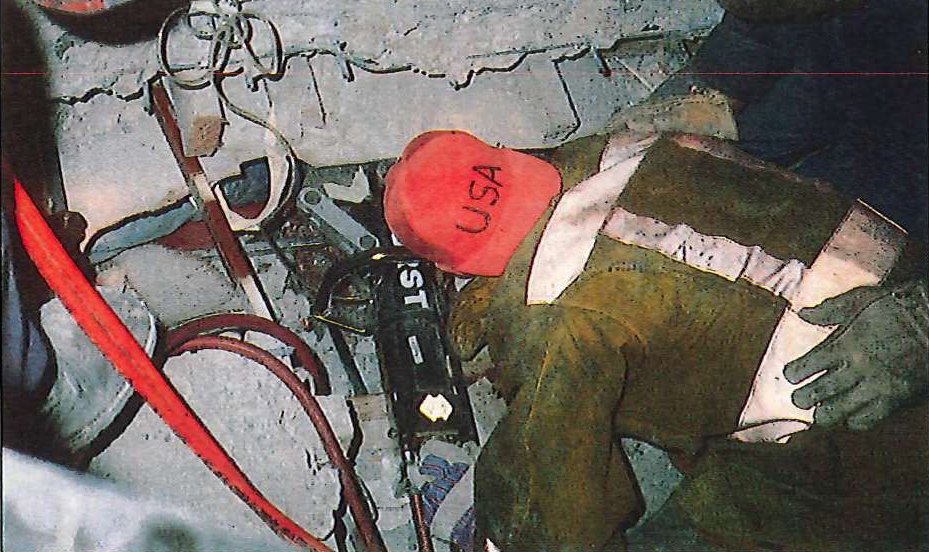
Triangular inspection holes in the ceiling accessing the victim were accomplished with very shallow cuts with an air chisel. The spirit and resolve of the American team was lifted when the victim’s hand emerged from one of the holes. The victim, a local man in his 30s, was remarkably aware of his condition and surroundings. Through the hole, he told his rescuers that he was seated with an associate in a conference room when the earthquake struck. As the hole was expanded, the man was found still seated in a chair, but in a horizontal position. He was confined in a 24-inch space between the ceiling and floor. The decaying body of his associate was discovered nearby. The surrounding ceiling and the victim’s chair were cut away with a reciprocating saw and removed. This enabled the victim to move freely, except for a large concrete beam pinning his left leg at the ankle.
SMRT physician Dr. Joe Barbera started an intravenous line while rescuers decided how to free the victim’s leg. An attempt was made to raise the beam off the victim with an air bag. Wood trim around the concrete member was cut with an air chisel and reciprocating saw to allow a space between the beam and the second floor. Unfortunately, space permitted the insertion of only a small bag that proved inadequate for such a heavy load.
Firefighters were becoming fatigued and discouraged. It appeared that releasing the victim’s foot would require a lengthy and difficult process of cutting the beam and the floor with only marginal chances of success. Amputation was a strong option at this point. Dr. Barbera suggested that the leg could possibly be released if the beam’s wood trim was cut away from the ankle. An air chisel was chosen for this task because the intensity of its impact can be varied. With a man controlling its power at the regulator, the air chisel was used to split and cut the wood trim from around the ankle. Attempts to pull the leg free brought screams of pain from the victim. The ankle would not budge.
Dr. Barbera administered morphine, which relaxed the victim and permitted the ankle to be manipulated. The morphine and several more minutes of cutting proved successful: The leg was pulled from beneath the beam. The victim was placed on a backboard and removed from the hole. Clearly a bond of friendship and humanity had developed between the victim and his rescuers.
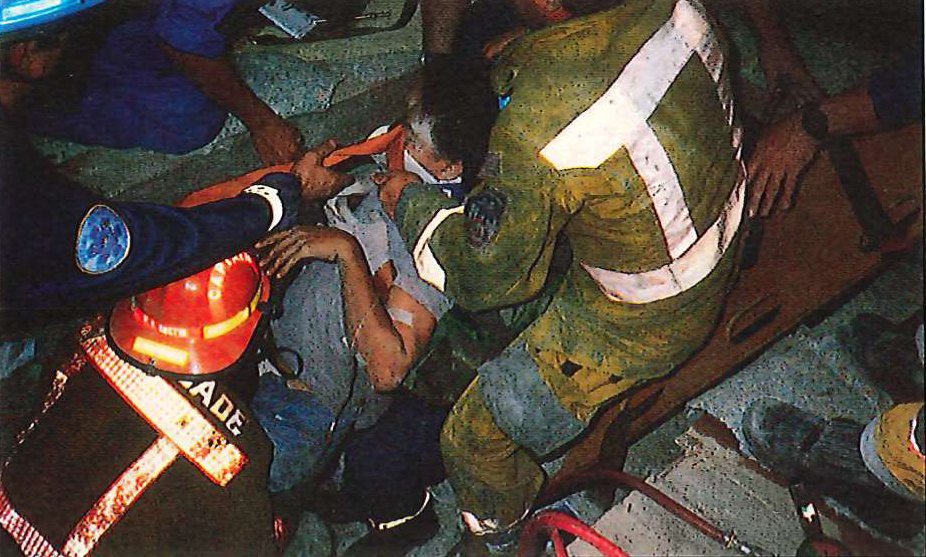
The Americans continued to penetrate concrete and explore voids. Several victims were discovered, but, unfortunately, they had been killed in the initial collapse or had succumbed to the effects of their entrapment. The team concept combining American rescue skills and Philippine mining experience was productive: six live victims were rescued after being entombed for 72 hours.
The command post began receiving reports from outlying areas of people trapped in buildings and mudslides. It was decided to redirect American operations from Baguio City to remote villages in the countryside.
One search and rescue group was transported by helicopter to the coastal village of Agoo, while a second group traveled by truck to small towns outside of Baguio. Despite warnings of hostility, the American firefighters were greeted with friendliness and appreciation wherever they traveled.
A building-by-building survey produced no victims in need of rescue. Eventually, reports received at the command post from the military and the Philippine government indicated a diminished need for American assistance. The team wrapped up operations after three days and returned to Clark Air Force Base aboard a C-130 cargo aircraft.
This mission tested all of the abilities required of an international rescue team member. Certainly, good rescue skills are paramount. Strength and stamina were necessary to work long hours without rest. It took courage to work in a dangerous situation so far away from home. It is just as important for team members to work with people. The objective of this (and all) international missions is to assist local rescue workers and augment their system whenever possible--NOT to take over operations. This support role is best carried out by tactful and diplomatic individuals who possess a sensitivity for diverse cultures.
Bill Gustin is a captain with the Metro-Dade County, Florida, Fire Department.
Photos in the article by Bill Gustin, except the backboard photo by Carlos Castillo.
© 1990 Firehouse. Reprinted with permission.
The original pages
 Page 36
 Page 38
 Page 39
 Page 40
 Page 42
Scans of the October 1990 issue, courtesy of Firehouse. Page 39 also carries an advertisement, and page 42 also carries “Plan Bulldozer,” a separate article by William Keith that is not reprinted here.
Honored for the Rescue
August – December 1990
The team honored by the commission was team leader Lt. Carlos Castillo, Capt. William Gustin, Lt. Cris Aguirre, Lt. John Mitchell, firefighter Angel De La Fuente and firefighter John Carroll. It was his second international earthquake deployment in less than two years.
Later that year the Herald reported that he had also been honored by the Philippine ambassador to the United States for helping in the rescue effort.
The original articles
Excerpt from the Herald’s Honored column.
Metro Commissioners honored the Metro-Dade Fire Department’s Special Disaster Response Team for its efforts in rescuing victims of the recent earthquake in the Philippines. The honored team members are team leader Lt. Carlos Castillo, Capt. William Gustin, Lt. Cris Aguirre, Lt. John Mitchell, firefighter Angel De La Fuente and firefighter John Carroll.
© 1990 The Miami Herald. Reprinted with permission.
Excerpt, December 7, 1990.
Dade County Mayor Steve Clark recently honored Metro-Dade Fire Department Capt. William Gustin for being named Florida Fire Fighter of the Year at a State Fire Prevention conference in October. Clark also commended fire safety representative Clara Hernandez for being named the state’s first public fire safety educator of the year at the conference.
Gustin is a 13-year veteran of the department who has been honored by former President Ronald Reagan for his rescue efforts during the Armenian earthquake disaster and by the Philippines ambassador to the United States for helping in the rescue effort of earthquake victims in that country.
© 1990 The Miami Herald. Reprinted with permission.